A party can put “Socialist” in its name without turning every business into a public enterprise. In Spain, the clearest way to tell the difference is to look at what the constitution protects and then see who runs the trains and who runs the electricity grid.
No, Spain is not a socialist country if socialism means an economy organized around social ownership or control of most productive resources. Spain’s constitution recognizes private property and freedom of enterprise in a market economy, alongside public enterprise and legal intervention. The Socialist Party’s role in the coalition formed in November 2023 describes who governed, not who owned the economy.
How to use this article: Check the three constitutional articles, see what changed when the 2023 coalition formed, and compare who can run trains with who runs the electricity grid.
Three economic provisions in Spain’s 1978 Constitution
Article 33
PropertyRecognizes private property and inheritance. The law limits the scope of these rights according to their social function. Taking property requires a justified public purpose or social interest, compensation and legal procedure.
BOE, Article 33 · May 20, 2026 consolidated text
Article 38
EnterpriseRecognizes freedom of enterprise in a market economy. Public authorities protect this freedom in line with the needs of the economy and applicable planning.
BOE, Article 38 · May 20, 2026 consolidated text
Article 128
Public interventionRecognizes public economic activity and makes all wealth subject to the general interest. A law may reserve essential resources or services to the public sector, especially in a monopoly, or authorize intervention in companies when the general interest requires it.
BOE, Article 128 · May 20, 2026 consolidated text
1. A party label is not an economic system
Political debate uses “socialist” for everything from a party’s name to a policy that expands public services. This article uses the ownership-and-control test explained in the Stanford Encyclopedia of Philosophy’s entry on socialism: the question is who ultimately controls most of the resources used to produce goods and services. The definition does not rule out markets under every form of socialism. It does distinguish a system organized around social control from a market economy that also has public companies.
What the November 2023 coalition changed
Pedro Sánchez announced a coalition between the Spanish Socialist Workers’ Party (PSOE) and Sumar on November 20, 2023. The new cabinet took office the next day. That is a dated example of a government led by a party with Socialist in its name, not a claim about the current cabinet. An investiture gives a government authority to govern under the constitution; changing the constitutional text requires a separate process.
2. What the Spanish constitution says about ownership
Read Articles 33, 38 and 128 together
One article recognizes private property, another protects business activity in a market economy, and a third defines what public authorities may do in the same economy. These provisions are not competing labels. They describe rights and powers that operate together.
Article 1 calls Spain a social and democratic state governed by law and identifies its political form as a parliamentary monarchy. “Social” in that sentence should not be silently read as “socialist.” The provisions above show why: the same text protects private property and provides for public action. It does not specify how large either sector must be.
3. How this works in rail and electricity
Buying a train ticket and paying an electricity bill illustrate different relationships between public and private business. Keep two questions separate: who manages the network, and who is allowed to sell a service that uses it?
Rail: public operator, competing services
2024 evidence: Public Renfe sold commercial high-speed tickets under AVE and Avlo. Iryo and Ouigo also sold tickets and together accounted for 34% of commercial high-speed journeys, according to Spain’s competition regulator, CNMC. INE’s passenger statistics identify the same four brands in their high-speed category.
It was not necessary to privatize Renfe to allow rival operators. And the regulator’s figure is a share of journeys on one type of service, not the share of Spain’s railway network or assets owned by those operators.
Electricity: a regulated grid, competing suppliers
2024 evidence: State holding company SEPI owned 20% of Redeia, the parent of transmission grid operator Red Eléctrica, at year-end. Article 8 of the Electricity Sector Law treats transmission and distribution as regulated activities and generally allows competing retail suppliers under separate rules.
The 20% refers to shares in Redeia, not a fraction of Spanish electricity or of the power lines. A customer can change supplier without the local wires changing ownership.
The railway percentage measures service use. The electricity percentage measures a stake in a specific company. They answer different questions and cannot be added up to measure how much of Spain’s economy is publicly owned.
Frequently Asked Questions
Does Spain’s constitution recognize worker cooperatives?
Yes. Article 129.2 directs public authorities to promote participation in enterprises, encourage cooperatives and help workers gain access to ownership of productive resources. That is a provision for particular forms of ownership, not a requirement that every firm become a cooperative.
Does EU membership require Spain to privatize its public companies?
No. Article 345 of the Treaty on the Functioning of the European Union leaves member states’ systems of property ownership in place. That does not exempt public companies or national rules from other applicable EU law.
What Did We Learn Today?
Start by asking whether a claim about Spain refers to a party, a constitutional rule or a business. Rail illustrates how public and rival operators can sell services on the same network. Electricity shows why a government shareholding and the rules for retail competition are different things.
Sources & Data Notes
The constitutional summary follows the May 20, 2026 consolidated Spanish text. The government example is from November 2023; both sector examples use 2024 evidence. The two industries illustrate how the rules work; they do not measure the entire economy.
- Spanish Official State Gazette, consolidated Constitution.
- Congress of Deputies, bilingual Spanish Constitution and Stanford Encyclopedia of Philosophy, Socialism (2024 archive).
- La Moncloa: November 20, 2023 coalition announcement and XV Legislature cabinet chronology.
- CNMC passenger rail liberalization assessment (2025), 2024 results; Renfe-Operadora’s public enterprise status; INE, 2024 passenger transport release (provisional) corroborates which brands the category includes, not CNMC’s share.
- Electricity Sector Law, Article 8; SEPI, 2024 annual report; Redeia, 2024 annual accounts.
- EU treaty, Article 345; Court of Justice, Opinion 2/15, for the scope of EU neutrality on ownership.
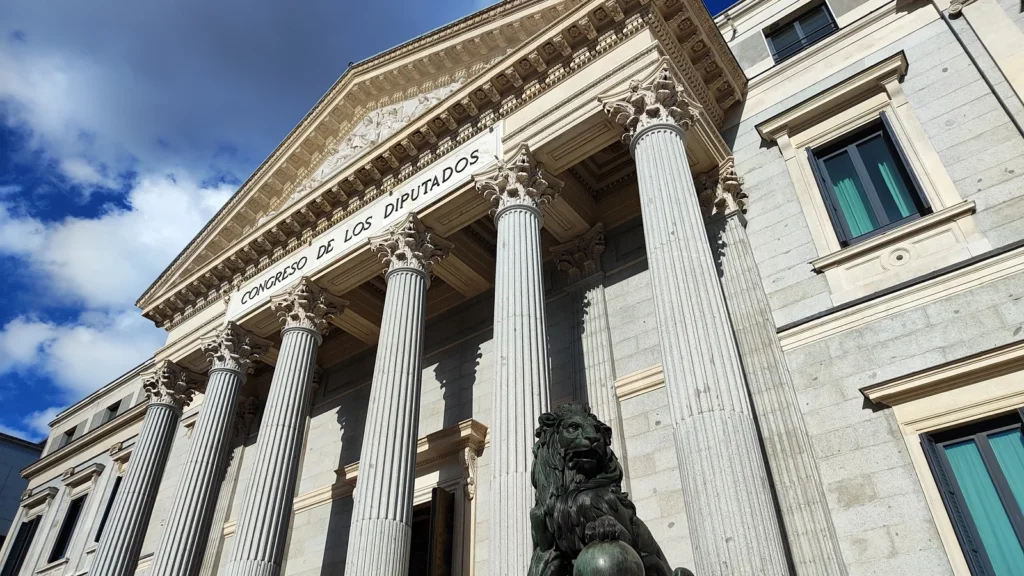
- Cover photograph: Mentxuwiki, Palacio de las Cortes, December 2, 2023, CC BY-SA 4.0, cropped and resized; adapted image under the same license.