At the December solstice, Rovaniemi gets a little over two hours between sunrise and sunset, while farther north the Sun does not rise at all in Tromsø or Longyearbyen. All three have continuous daylight at the June solstice in the same horizon model. It takes two questions to make sense of the contrast: does the Sun rise, and how bright does the sky get when it does not?
Polar night is a period without sunrise. Midnight sun is a period without sunset. Both happen because Earth’s tilt shifts the daily solar path up or down with the seasons, most noticeably at high latitudes. Polar night does not rule out twilight: the Sun can stay below the horizon while the upper atmosphere scatters enough light to brighten the sky.
Compare the light: Read the two solar paths or see what changes between December and February in Longyearbyen.
Why the Sun’s path moves above or below the horizon
Earth’s axis tilts about 23.4° from the perpendicular to its orbital plane. In northern summer that tilt puts the Arctic on the sunward side. As Earth turns each day, the Sun circles low around the horizon at high latitudes rather than making the steep daily arc seen closer to the equator. Far enough north, even its low point is high enough for part of the disk to remain visible. In northern winter, the arc is lower. Far enough north, even its high point is too low for sunrise.
The Arctic Circle, about 66.56°N, sketches this transition using the geometry of the Sun’s center and an ideal horizon. It is not a sharp boundary for what somebody sees from a street or a mountaintop. The Sun has an upper edge, and the atmosphere bends its light upward near the horizon. The standard sunrise calculation allows for both: the solar center is about 0.83° below the ideal horizon when the upper edge is taken to appear. Rovaniemi is close enough to the Circle for that distinction to matter.
Three places on the same two solstice dates
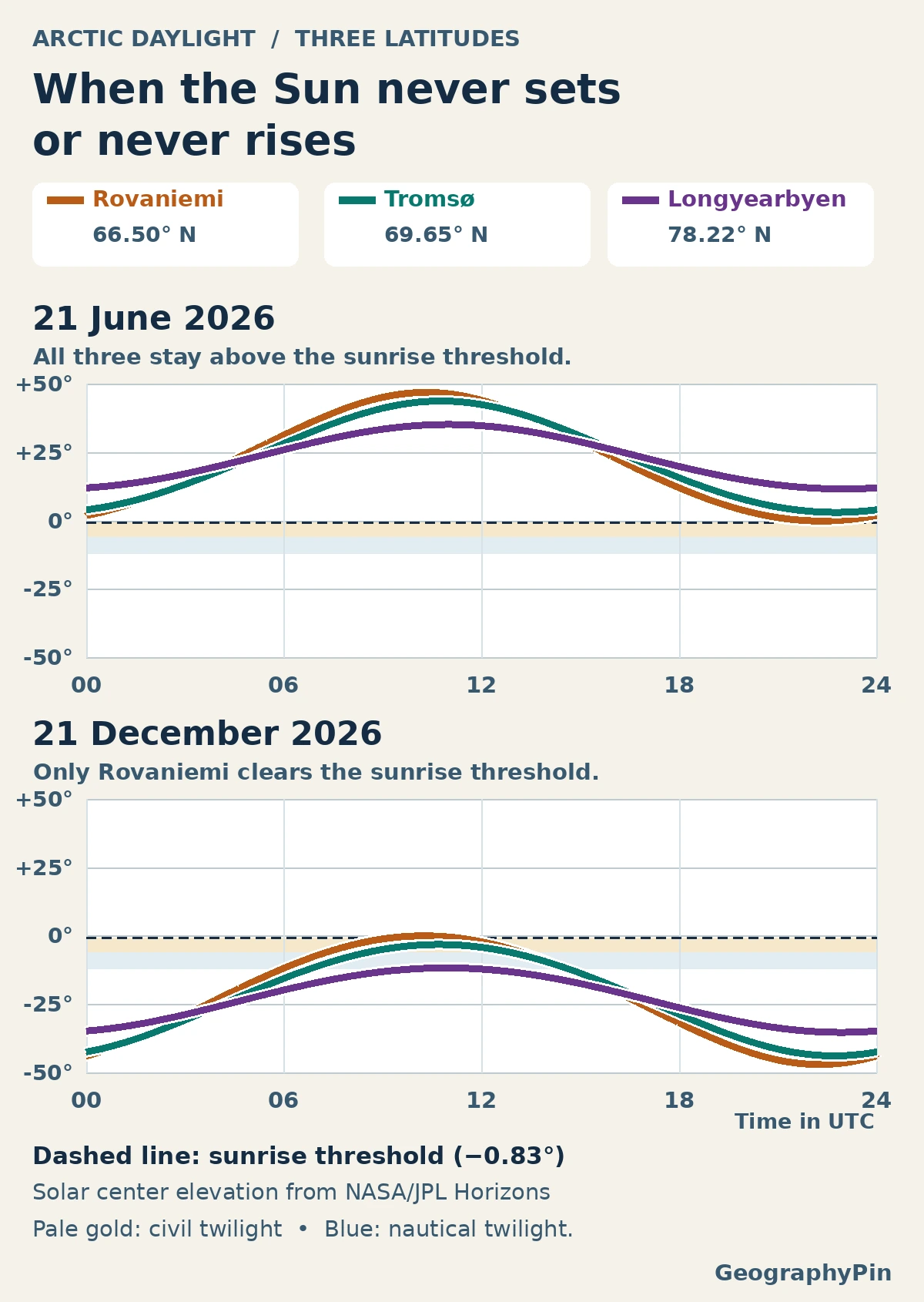
Read the two graphs against the same dashed line. A curve always above it means no sunset; a curve always below it means no sunrise. Each curve traces the same 24 hours in UTC. The elevations are calculated for the Sun’s center over an unobstructed horizon.
| Location | June 21, 2026 | December 21, 2026 |
|---|---|---|
| Rovaniemi, 66.50°N | 24 hours | About 2 h 15 min |
| Tromsø, 69.65°N | 24 hours | 0 hours |
| Longyearbyen, 78.22°N | 24 hours | 0 hours |
The three June results sound identical until you look at the bottom of each curve. The Sun’s center dips just below geometric zero in Rovaniemi (about −0.07°), but under the standard convention its upper edge does not set. The low point is about 3.1° above geometric zero in Tromsø and 11.7° in Longyearbyen. The farther-north sites have more room for the solar path to drop seasonally before it first intersects the horizon. They generally keep the midnight sun for longer, and also spend longer in polar night.
How Longyearbyen gets light without sunrise
On December 21, the Sun’s center reaches only about −11.7° at Longyearbyen. It briefly reaches the range called nautical twilight, between 6° and 12° below the geometric horizon, but stays too low for civil twilight. On February 7, the same model puts its high point around −3.5°. That still means no sunrise, but the Sun is less than 6° below the horizon for a little over five hours. That entire window is civil twilight because the Sun never reaches the sunrise threshold. In Tromsø, civil twilight is possible even on the December date with no sunrise.
Twilight comes from sunlight scattered through the atmosphere, so the sky can glow without direct sunlight reaching the observer. Cloud and the local skyline affect what people actually see. The label blue hour describes an appearance, not a separate fixed solar-angle boundary or a guarantee of color. An aurora or a full Moon can light the sky too, but neither marks sunrise or proves that twilight is in progress.
What two days can and cannot establish
Two full-day curves are enough to compare the illustrated dates, not to name the first sunset of the year or the first morning Sun reaches a particular building. To find the beginning or end of a season, check successive dates using the same definition and horizon. A mountain can block the low Sun even after the astronomical sunrise date. Low cloud can obscure it without changing the underlying day length.
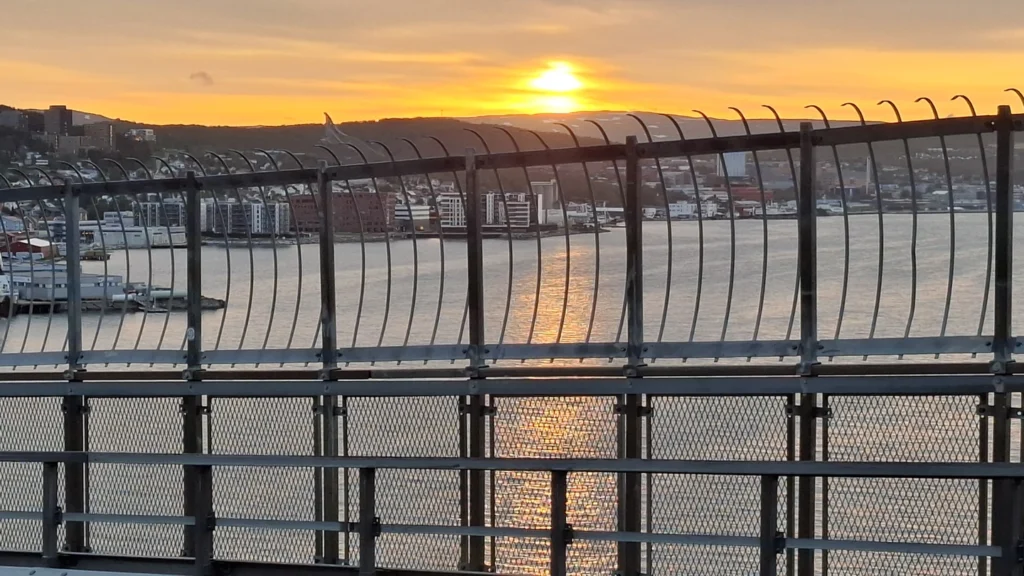
A single photograph can show an illuminated horizon, but without a time series it cannot distinguish a Sun about to set from one that will stay up all night. The featured image shows the low Sun shortly after midnight by the clock in Tromsø in July 2025. The charts are a separate calculation for 2026, not a reconstruction of the photographed moment.
Frequently Asked Questions
Is midnight sun defined by the clock striking midnight?
No. It means the Sun does not set through the daily cycle. The Sun is closest to the horizon around local solar midnight, which need not coincide with 00:00 on a civil clock.
Can a town just south of the Arctic Circle have a day without sunset?
Yes, under the standard upper-edge and refraction convention, as the Rovaniemi June calculation shows. How much of the disk you can see depends on the actual horizon and the air near it.
Does Antarctica have midnight sun at the same time as the Arctic?
No. Around the December solstice the south polar region is tilted toward the Sun, so the southern polar summer corresponds to northern polar winter.
Does polar night mean an aurora is visible all day?
No. Polar night can allow a dark sky at hours that would otherwise be bright, but an aurora still has to occur and be visible through the atmosphere. Daytime twilight can wash out a faint display.
What Did We Learn Today?
The daily low point tells you whether the Sun sets. The high point tells you whether it rises, or how far into twilight it gets. At 78°N the Sun can pass from a low December glow to a much brighter February twilight before the first sunrise.
Sources & Data Notes
- NASA/JPL Horizons: Sun (target 10), airless apparent elevation of the solar center, Earth surface, observer quantity 4. Computed for representative observer positions at reference elevation zero: Rovaniemi 66.50°N, 25.73°E; Tromsø 69.65°N, 18.96°E; Longyearbyen 78.22°N, 15.65°E. One-minute samples in UTC per date; durations rounded by counting sampled minutes at or above the relevant threshold. The curves hold the region, dates, angles and convention consistent; they do not model mountain skylines or the weather.
- U.S. Naval Observatory rise, set and twilight definitions: standard apparent sunrise at a center elevation of −50 arcminutes and solar-center limits of −6°, −12° and −18° for civil, nautical and astronomical twilight. USNO 2026 solstice dates.
- NSIDC, Arctic weather and climate, for axial tilt and polar seasons; Visit Svalbard’s local polar-night account for twilight and local conditions, not the source of the calculated daylight durations.
- Featured image: Midnight sun in Tromsø, Kawon Kez Sel, July 7, 2025, CC0 1.0; cropped and converted to WebP. In-body graphic by GeographyPin.
