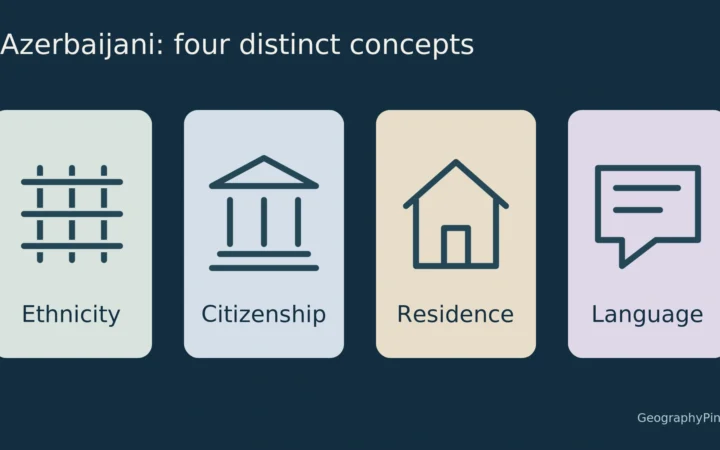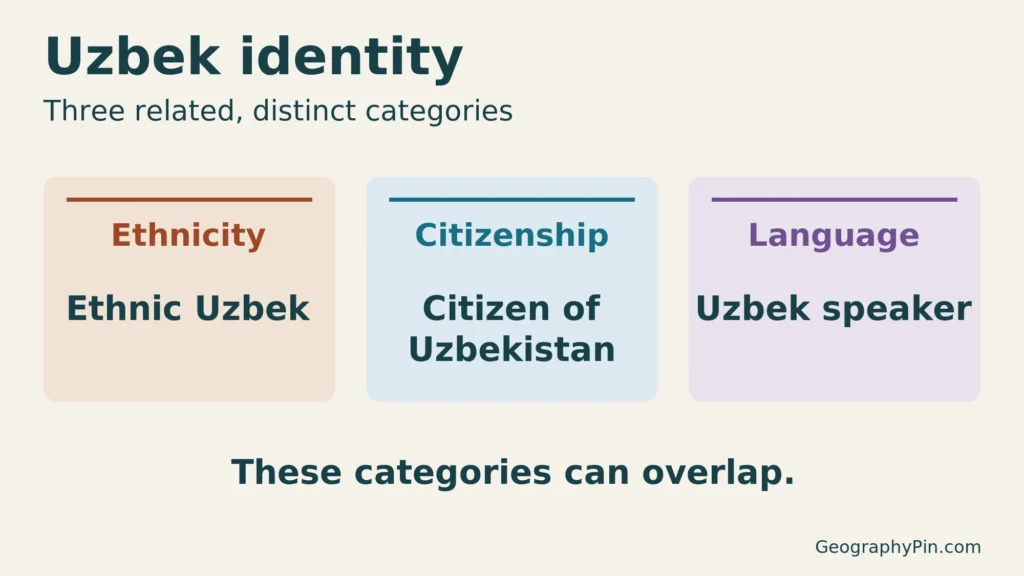
“Uzbek” can describe a person’s ethnic identity, a language or something associated with Uzbekistan. The meaning depends on the context, and confusing those uses can turn a statement about a country into an inaccurate claim about everyone who lives there.
A people, not simply a passport
Uzbeks are an ethnic group rooted in Central Asia, with communities in Uzbekistan and neighboring countries. Ethnic identity is not the same as citizenship, residence or language use: not every citizen of Uzbekistan is ethnically Uzbek, and an ethnic Uzbek need not live in Uzbekistan or hold its citizenship.
How to use this article: Separate ethnicity, citizenship and residence, read a dated community example, or clarify what Turkic means.
1. One word, several different meanings
Four descriptions that can overlap
| Description | What it identifies | What it does not establish |
|---|---|---|
| Ethnic Uzbek | An ethnic identity | A particular passport or current address |
| Citizen of Uzbekistan | Legal membership of the state | One ethnicity shared by all citizens |
| Resident of Uzbekistan | Where someone lives | Citizenship or ethnic identity |
| Uzbek speaker | Use or knowledge of the language | Ethnicity, citizenship or birthplace |
Article 8 of Uzbekistan’s Constitution defines the people of the state as all its citizens, without limiting that civic community to one ethnicity. The English text uses “nationality” for the distinction within that citizen body; here it should not be read as “citizenship.”
For clarity, use “ethnic Uzbek” when discussing ethnicity and “citizen of Uzbekistan” when discussing citizenship. “Uzbek” also works as an ordinary adjective for the state, as in an Uzbek government institution. Context matters more than imposing one label on every person.
2. Uzbek communities extend beyond Uzbekistan
The modern state of Uzbekistan is central to the subject, but its border does not contain every Uzbek community. A Max Planck Institute research account describes established communities in southern Kyrgyzstan, northern and western Tajikistan, southern Kazakhstan, northern Turkmenistan and northern Afghanistan, alongside migration diasporas farther afield.
These are different histories of belonging. It would be misleading to call every Uzbek outside Uzbekistan a recent immigrant from that country. A community’s place in a region and an individual’s migration history need to be established separately.
Kazakhstan’s 2021 census offers one clear example
Kazakhstan’s Bureau of National Statistics reported approximately 614,000 Uzbeks in its 2021 census, in a release published November 2, 2023. This is an ethnic-composition count in Kazakhstan, not a count of Uzbekistani passport holders, recent arrivals or Uzbek speakers. It is also not a 2026 population estimate.
When comparing community figures, keep the year and category attached to the number. An ethnicity count, a foreign-citizen register and a language survey answer different questions; adding them together does not produce a reliable worldwide total.
3. Speaking Uzbek is not an ethnicity test
Turkic describes a language family
Indiana University’s language portal classifies Uzbek within the Turkic family’s southeastern, or Karluk, branch and notes Persian, Arabic and Russian influences. “Turkic” here is a linguistic classification, not Turkish citizenship or a biological description of a person.
Uzbek is the state language under Article 4 of Uzbekistan’s Constitution, which also calls for respect for the languages and traditions of other ethnic groups. State-language status does not mean every resident has the same first language.
Someone can learn Uzbek without becoming ethnically Uzbek; conversely, an ethnic label does not tell you which language a person uses at home, at work or most comfortably. If the question is language ability, ask about that directly rather than substituting a question about origin.
4. History and local life both shape identity
Historian Adeeb Khalid’s Making Uzbekistan examines the formation of modern Uzbekistan through the interaction of local Muslim intellectuals, local Bolsheviks and Moscow in the early Soviet period. His interpretation gives local actors a role that a simple story of a nation imposed entirely from outside would miss.
At the level of everyday identity, anthropologist Peter Finke’s discussion of his fieldwork emphasizes locality and shared social life as well as ancestry. His work explores variation within Uzbek identity, rather than presenting one family history or cultural pattern as universal.
These are related but distinct questions. The history of a modern state is not identical to the history of an ethnic name, and neither is a complete account of how an individual understands belonging. Historical research can explain change without reducing people to an origin formula.
5. Shared traditions do not make everyone the same
Shashmaqom music is a useful cultural example: UNESCO recognizes it jointly for Tajikistan and Uzbekistan. The tradition combines vocal and instrumental music and poetry, reflecting connections across the region rather than a cultural boundary that follows a single state border.
UNESCO’s account of palov culture in Uzbekistan similarly describes making and sharing food as a social practice in rural and urban communities. The Uzbek food guide explores the dishes themselves; here, the point is the role of a shared practice, not a test of who counts as Uzbek.
Such examples do not mean that every Uzbek performs the same music, eats the same dishes or follows one set of customs. Nor can a person’s religious beliefs, appearance or personality be read from an ethnic label. Let people describe their own affiliations rather than treating a photograph, surname or tradition as proof.
What Did We Learn Today?
Uzbek identity, citizenship, residence and language can overlap without describing the same thing. Regional communities, local histories and shared cultural practices help explain the people beyond a passport or border. Keeping those distinctions clear makes both a census figure and a conversation about identity more accurate.
Sources & Data Notes
View identity, history and census sources
Sources checked November 18, 2026. The Kazakhstan figure is the rounded ethnic-composition result for the 2021 census, published in 2023; it is not a current estimate. Historical and anthropological sources provide interpretations, not legal definitions of membership. The definitions table separates concepts and is not a test for assigning someone an identity. No worldwide total or unverified current ethnicity percentage is presented.
- Uzbekistan Constitution, Articles 4 and 8
- Indiana University: Uzbek language classification
- Max Planck Institute: Uzbek communities and identity research
- Peter Finke: discussion of Variations on Uzbek Identity
- Adeeb Khalid: Making Uzbekistan, publisher abstract in Cornell repository
- Kazakhstan statistics bureau: 2021 census ethnic composition
- UNESCO: Shashmaqom music
- UNESCO: palov culture and tradition