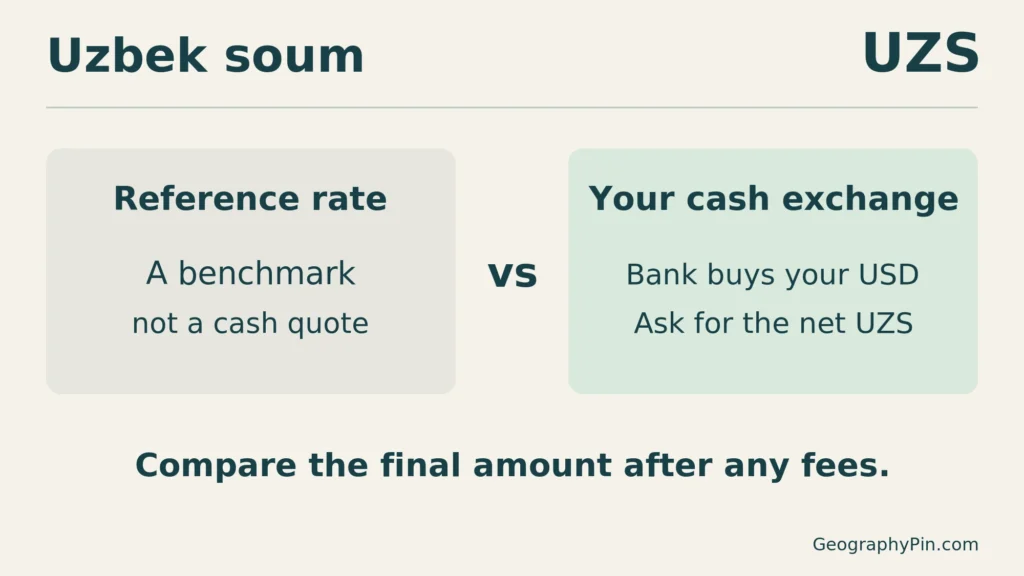
A currency code tells you what is on the bill, but not whether your card will work or how much cash an exchange counter will hand over. For Uzbekistan, those are separate checks: recognize the soum, plan the cash you need, then compare the actual conversion terms.
Soum in your wallet, UZS on the screen
Uzbekistan uses the soum, written so’m or som and abbreviated UZS. Carry some local cash alongside your card, especially before leaving the main cities. For exchange, compare the amount you will actually receive, not just the central-bank reference rate; at a card terminal, check who is offering the currency conversion.
Money and customs information checked: November 18, 2026. The exchange example is dated, not a live rate or an offer.
How to use this article: Work out your cash before a transfer, follow the conversion example, or check the border declaration rules.
1. Recognize the soum and its denominations
The Central Bank of Uzbekistan’s circulation catalogues list the denominations below. Their archives also show withdrawn money, so an old photograph is not proof that a note remains usable. Several denominations have more than one issue design.
| Form | Values in soum |
|---|---|
| Banknotes | 1,000; 2,000; 5,000; 10,000; 20,000; 50,000; 100,000; 200,000 |
| Coins | 50; 100; 200; 500; 1,000 |
A 1,000-soum coin and a 1,000-soum note therefore represent the same amount. For small purchases, ask whether change is available before handing over a large note. Check the printed value rather than identifying money solely by color.
2. Plan cash around the next leg of your trip
Set aside money for the journey, not just the destination
UK travel advice warns that international-card acceptance and compatible ATMs are limited outside the main cities. It identifies U.S. dollars as the easiest foreign currency to exchange and advises using official exchange booths. Bring clean, unmarked foreign notes and confirm acceptance with the bank.
That does not mean every payment must be cash. Ask your accommodation whether it accepts your particular foreign card, whether payment is due before arrival, and what remains payable locally. A booking confirmation marked “pay at property” does not answer those questions.
- Before arrival: decide how you will pay for the transfer and the first small purchases.
- Before a regional trip: list the costs still unpaid, including the return journey, and arrange that cash before leaving the city.
- Before relying on a card: check overseas use, withdrawal limits and charges with its issuer.
- Before withdrawing: read the machine’s currency, amount and fee screens. Do not assume the next ATM has the same terms.
A useful cash plan is built from your own bookings, not a fixed daily allowance. Separate prepaid costs from those still due, add a reserve for a delayed transfer, and keep the departure journey in the calculation. The Uzbekistan travel guide helps put those decisions alongside your route.
3. Read the quote from the bank’s side
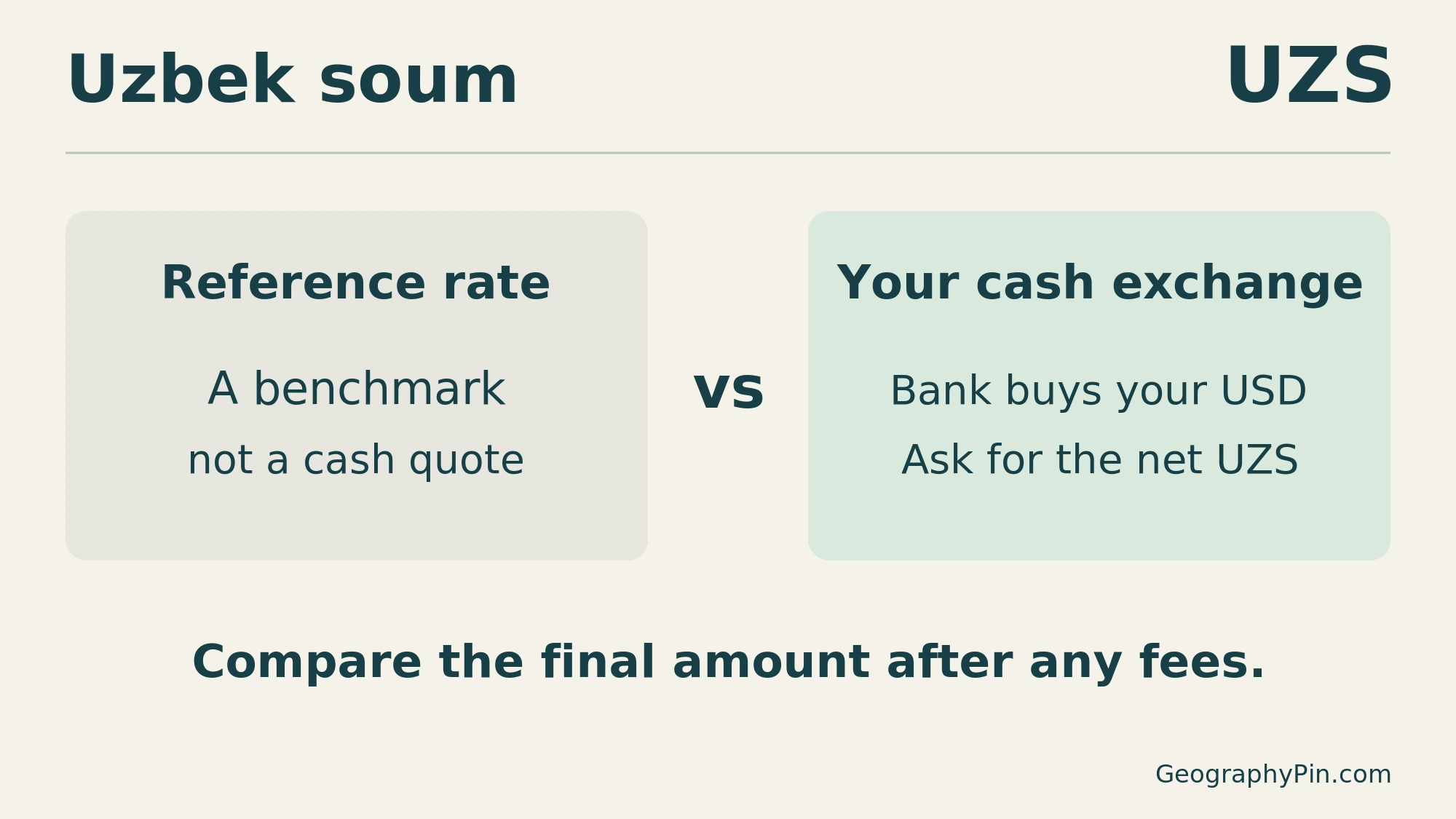
In Ipoteka Bank’s terminology, buy means the bank buys your foreign currency; sell means it sells foreign currency to you.
The central-bank rate is a reference, not a retail offer. Commercial buy and sell quotes differ, and a bank’s branch, ATM and app can use different rates. The gap between buy and sell is the spread; it is distinct from a separately charged fee.
A dated dollar-to-soum calculation
The Central Bank’s rate for November 18, 2026 was 12,010.45 UZS per US$1. Using that reference solely to demonstrate the arithmetic:
US$100 × 12,010.45 UZS per dollar = 1,201,045 UZS.
This is a dated illustration before any retail spread or fees, not today’s guaranteed payout. For a rough reverse conversion, divide a soum amount by the quoted number of soum per dollar.
Before exchanging, ask how many soum you will receive after any fee. Count the notes and check the receipt at the counter. Get a fresh quote when exchanging leftover soum.
4. Check the currency before approving a card payment
A terminal or ATM may offer to bill you in your home currency instead of UZS. This is dynamic currency conversion, or DCC. Visa’s consumer guidance says the offer should show both currency amounts, the conversion rate and additional fees or markup, and let you accept or decline.
Choose UZS if you want to decline the merchant’s or ATM’s conversion offer. That choice concerns conversion, not whether you want to make the purchase or withdrawal. Read the actual screen rather than relying on the color or position of its buttons.
Do not treat “no conversion” as “no charges.” Check your issuer’s foreign-use terms and any ATM charge separately. If the conversion details are missing or you feel pressured to accept, Visa recommends declining the conversion and reporting the incident to your issuer.
Keep the receipt until the transaction appears in your account, and compare the currency and amount you approved.
5. Keep the right documents when crossing the border
The threshold is in soum, not a fixed dollar amount
Under Uzbekistan’s cash-border rules, individuals may bring cash into the country without an amount ceiling, subject to customs requirements. If the combined national and foreign cash exceeds 100,000,000 UZS equivalent, declare the full amount, not just the excess. Smaller amounts may be declared voluntarily.
Taking cash out is different. Up to 100,000,000 UZS equivalent is permitted subject to customs control; above that, a specified exception is necessary. For a nonresident traveler, one exception covers the unused balance of funds declared on entry, supported by that declaration. Other narrow documented exceptions exist. Do not assume that citizenship alone determines residence status or that completing a declaration makes any larger export permissible.
The Tourism Committee’s November 2026 reminder says the equivalent is calculated using the Central Bank rate on the day you cross the customs border. Keep your declaration copy until departure and ask customs about uncertain cases before passing through control. These cash rules concern physical currency, not the balance available on your bank card.
What Did We Learn Today?
A good money plan separates three decisions: how you will pay, who will convert the currency, and what paperwork your cash requires at the border. Work from unpaid bookings and the next journey, compare net amounts rather than headline rates, and keep the records that explain what you exchanged or declared.
Sources & Data Notes
View money sources and calculation notes
Checked November 18, 2026. Denominations follow the Central Bank’s circulation listings, not every item in its historical archives. The example multiplies US$100 by the reference rate effective November 18; it is not a live converter. Actual card acceptance, exchange quotes and fees require a check with the provider. Customs rules are summarized for ordinary individual travelers; residency and documented exceptions matter.
Graphic: original GeographyPin illustration, informed by Ipoteka Bank guidance.
- Central Bank: circulating banknotes
- Central Bank: circulating coins
- Central Bank: exchange-rate reference
- Ipoteka Bank: commercial quotes and rate terminology
- UK travel advice: money and card availability
- Visa: dynamic currency conversion
- LexUZ: rules for taking cash across the border
- Tourism Committee: cash declaration reminder