A king may formally appoint a prime minister without being free to choose whoever he wants. Another monarch may exercise substantial governing authority. Understanding monarchy means separating the title, the way its holder is selected and the powers the office actually carries.
A monarchy is a political system in which a sovereign holds a monarchical office, with titles such as king, queen or emperor. Succession is often hereditary but can be elective. The monarch’s powers vary widely: some mainly perform constitutional and ceremonial duties, while others exercise substantial authority over government.
How to use this article: Compare the two leadership roles, see how an elected monarch works, or distinguish formal powers from governing decisions.
1. Monarchy describes an institution, not one level of power
The monarch is an officeholder within a particular constitutional and historical arrangement. Monarchy does not mean that every public decision is personally made by a royal individual. It also does not require every monarch to use the English title king: Japan’s institution is headed by an emperor, while other systems use titles such as emir or sultan.
A useful definition therefore needs three questions. How is the office filled? What legal functions belong to it? Who makes and answers for ordinary governing decisions? Two countries can share the label monarchy while answering those questions very differently.
The institution should also be distinguished from the royal family. A monarch’s relatives do not all hold sovereign authority simply because they have titles. Nor does the survival of traditional kings or hereditary leaders within a republic automatically turn the national state into a monarchy. The relevant question is the state-level constitutional arrangement.
2. Head of state and head of government are different roles
Who represents the state, and who runs the government?
Canada’s Privy Council Office makes the distinction explicit: the King is head of state, while the prime minister is head of government. Most sovereign functions in Canada are exercised by the governor general, normally on ministerial advice. The same document recognizes exceptional circumstances, so “ceremonial” should not be mistaken for “constitutionally irrelevant.”
- King → head of state. The governor general exercises most sovereign functions in Canada.
- Prime minister and Cabinet → government. They lead policy and normally advise the Crown’s representative.
- House of Commons → confidence. The government must retain the confidence needed to govern.
This is a simplified Canadian role diagram, not a universal chart for all monarchies.
The distinction explains why a formal appointment and a political choice may belong to different actors. A constitutional text can assign an act to the monarch while convention determines whose advice guides it. Read the appointment rule together with the responsibility and confidence rules, rather than treating the signature alone as proof of personal control.
3. Succession can be hereditary or elective
Hereditary succession follows rules connected to a dynasty or family. It does not necessarily mean that the eldest child inherits in every country. Eligibility, order of succession and procedures for a vacancy vary. Japan’s Constitution, Article 2, describes dynastic succession governed by the Imperial House Law, rather than leaving it to an unrestricted personal nomination.
An election need not be a popular presidential vote
Malaysia supplies a clear counterexample to the claim that every monarch automatically inherits the national office. Article 32 of its Federal Constitution provides for the Yang di-Pertuan Agong to be elected by the Conference of Rulers for a five-year term. The choice is made within the constitutional royal framework, not through an ordinary national presidential election.
Hereditary and elective describe succession, not the extent of governing power. An elected monarch can still belong to a constitutional monarchy. A hereditary monarch can have tightly constrained political functions. Keeping these two dimensions separate prevents a common mistake: treating every category of monarchy as mutually exclusive.
4. Constitutional and absolute arrangements
Read legal powers alongside conventions
In the United Kingdom, the Royal Household’s explanation says the monarch remains politically impartial. Appointment of a prime minister is constrained by convention and the ability to command House of Commons confidence. That is different from a monarch personally directing the political program simply because the formal appointment occurs at the palace.
Japan’s Constitution makes a particularly clear distinction: Articles 3–4 place state acts under Cabinet advice and approval and exclude governmental powers from the Emperor. Article 6 assigns the formal appointment of a prime minister designated by the Diet. By contrast, Australia’s foreign ministry describes Saudi Arabia as an absolute monarchy, with a king-appointed Council of Ministers.
“Absolute” does not mean that the state has no laws, officials, religious rules or administrative institutions. It distinguishes a concentration of royal authority from arrangements in which governing power is limited and exercised through other accountable institutions. Conversely, merely possessing a constitutional document does not establish that a monarch is purely ceremonial.
| Example | Dimension illustrated | What to notice |
|---|---|---|
| United Kingdom | Constitutional role constrained by convention | Prime-ministerial appointment depends on Commons confidence. |
| Canada | Monarch and representative distinct from government | The governor general normally acts on ministerial advice. |
| Japan | Dynastic institution with specified state acts | The Constitution excludes governmental powers from the Emperor. |
| Malaysia | Elective national monarchy | The Conference of Rulers elects the monarch for a five-year term. |
| Saudi Arabia | Absolute monarchy in DFAT’s description | A Council of Ministers is appointed by the King. |
5. Monarchy and democracy answer different questions
Monarchy and democracy are not direct opposites. Monarchy describes a state institution and its succession; democracy concerns political participation, electoral competition, rights and accountability. A country can retain a hereditary monarch while elected representatives and ministers exercise democratic governing authority.
Norway’s parliamentary explanation of its Constitution separates legislative, executive and judicial branches and describes how people exercise legislative and supervisory authority through the Storting. Constitutional terminology must be read with the whole institutional structure, rather than assuming that a reference to the King means personal rule.
The reverse caution matters too. Calling a country a republic does not guarantee free elections or effective limits on executive power. For assessments of restricted competition, the authoritarian countries reference explains source-specific classifications. Monarchy, republic and dictatorship are not three interchangeable positions on a single scale.
6. A shared monarch does not mean a shared government
One person can occupy monarchical offices in more than one independent country. That does not merge those countries into one state or place their elected governments under another country’s prime minister. The office operates within each country’s own constitutional arrangements.
The United Kingdom and Canada illustrate the distinction. The shared monarch’s British constitutional functions relate to British institutions, while the Canadian role is exercised through Canadian constitutional arrangements and advice. A shared royal person is not a shared Cabinet, parliament or national electorate.
It follows that a list of monarchs and a list of monarchies answer different questions. Counting people can undercount states that share a monarch; counting every royal title can overcount sovereign institutions. For understanding a particular country, identify the office, its succession rules and its governing constraints before drawing conclusions from the title alone.
Frequently Asked Questions
Is a queen consort the same as a reigning queen?
No. A reigning queen holds the monarchical office in her own right; a queen consort’s title comes from being the monarch’s spouse. The title alone does not make a consort a separate sovereign officeholder.
Does a regent become a new monarch?
Not simply by acting as regent. A regency allows another person to perform specified functions on the monarch’s behalf under the relevant rules. Japan’s Constitution, for example, distinguishes acts performed in the Emperor’s name from holding the imperial office.
What Did We Learn Today?
Monarchy does not tell you everything about how a country is governed. Succession, formal state duties and effective governing authority are separate questions. Hereditary and elective arrangements can coexist with constitutional limits, while a shared monarch does not merge independent governments.
Sources & Data Notes
The examples explain institutional arrangements, not a complete inventory or a ranking of democratic quality. The role diagram is an original simplification of Canada’s official constitutional explanation. Legal wording is distinguished from conventions and governing practice; officeholders’ personal names are not needed for these comparisons.
- Royal Household: The Sovereign and the Prime Minister
- Canada Privy Council Office: Cabinet formation, May 2025
- Japan House of Councillors: Constitution, Articles 1–6
- Malaysia Federal Constitution: Article 32, official 2020 reprint
- Australian DFAT: Saudi Arabia country brief
- Storting: The Constitution
- Royal Collection Trust: consort and reigning queen distinguished
- Royal Household: the role of the monarchy
- Constitute: Malaysia Constitution, 2025 version, Article 32 cross-check
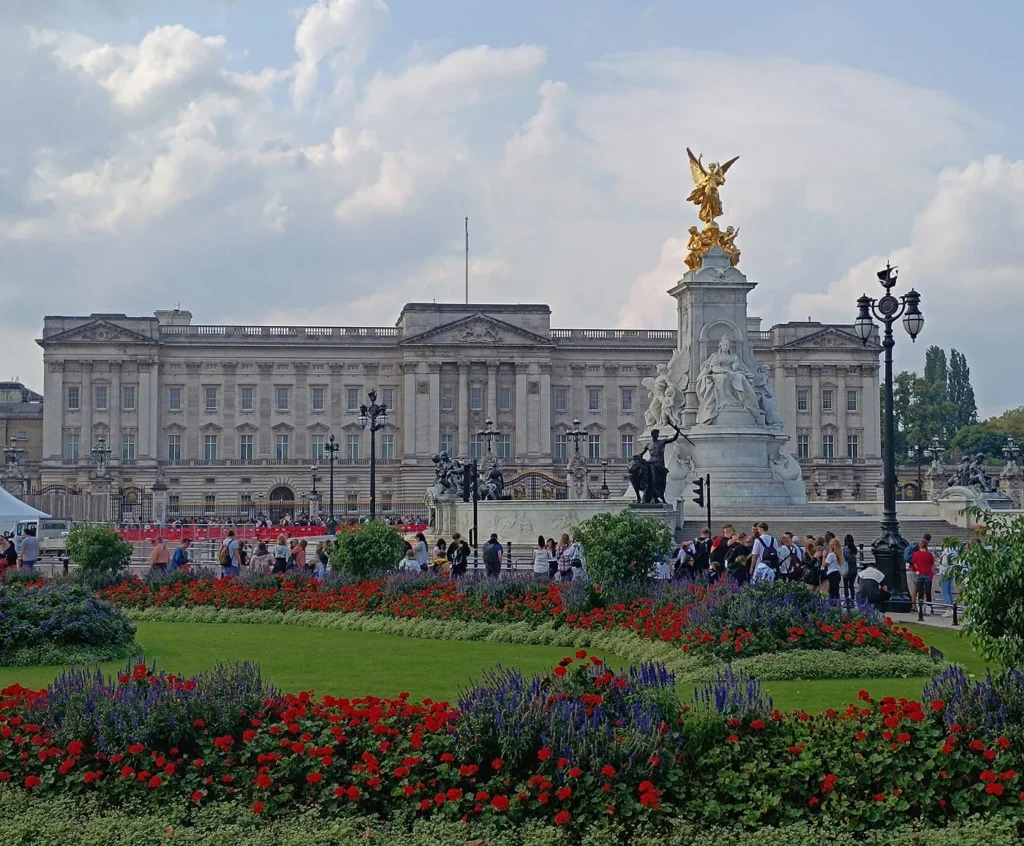
Featured photo: Hotolmo22, Buckingham Palace and the Victoria Memorial, 20 September 2024, CC0 1.0. Resized and converted to WebP; the source image includes its creator’s perspective and sharpness adjustments. This London scene illustrates one monarchy, not the powers of every monarch.