A country’s religious identity does not tell us who governs it. To understand theocracy, look at institutions: who holds power, how that person or body is chosen, and who decides whether laws meet religious requirements. Those details explain why apparently similar countries can work differently.
A theocracy is a system in which religious authority forms a basis of government and religious leaders or institutions exercise decisive political power. It can take different institutional forms. Having an official religion, a religious population, or laws influenced by religion does not, by itself, establish that a country is a theocracy.
How to use this article: Apply the institutional test, compare the forms of authority, or examine the selected examples.
1. What theocracy means
The useful question is not how religious a population is, but how religious authority connects to the state. This guide uses theocracy for government in which religious authority is a basis of ruling power and religious leaders or institutions exercise decisive political authority. Different systems can meet that description through different arrangements.
It is an institutional description, not a judgment about the sincerity of anyone’s beliefs. A country may contain many religious citizens without being governed by clergy. Conversely, the authority claimed by a government does not establish that every citizen accepts its religious interpretation.
Follow the authority, not the population’s religion
Ask who can issue binding decisions, who can block legislation, and how the highest rulers are selected. Then ask whether those powers belong to a religious office, a council applying religious criteria, or a political leadership claiming religious authority. These questions make the classification testable.
A religious symbol on a flag cannot answer them. Neither can the number of places of worship, the religion of the head of government, or an official holiday calendar. Those features may be culturally important, but they do not explain who has the final institutional word.
2. Religious and political authority can overlap differently
Three arrangements worth distinguishing
One arrangement unites a religious leadership position with state sovereignty. Another combines elected offices with institutions empowered to enforce religious constitutional rules. A third operates through a de facto leadership whose religious interpretation shapes binding decrees and governance, even when the constitutional framework is disputed or unclear.
These are analytical distinctions, not an official three-part ranking. A country can combine several characteristics. The relevant evidence is the distribution of power, rather than finding one label broad enough to replace every other description.
Monarchy and theocracy are therefore not mutually exclusive. Monarchy concerns the head-of-state institution; theocracy concerns the connection between religious and governing authority. A system can be monarchical without clerical government, while a republic can retain powerful religious supervisory institutions.
3. Selected examples and their limits
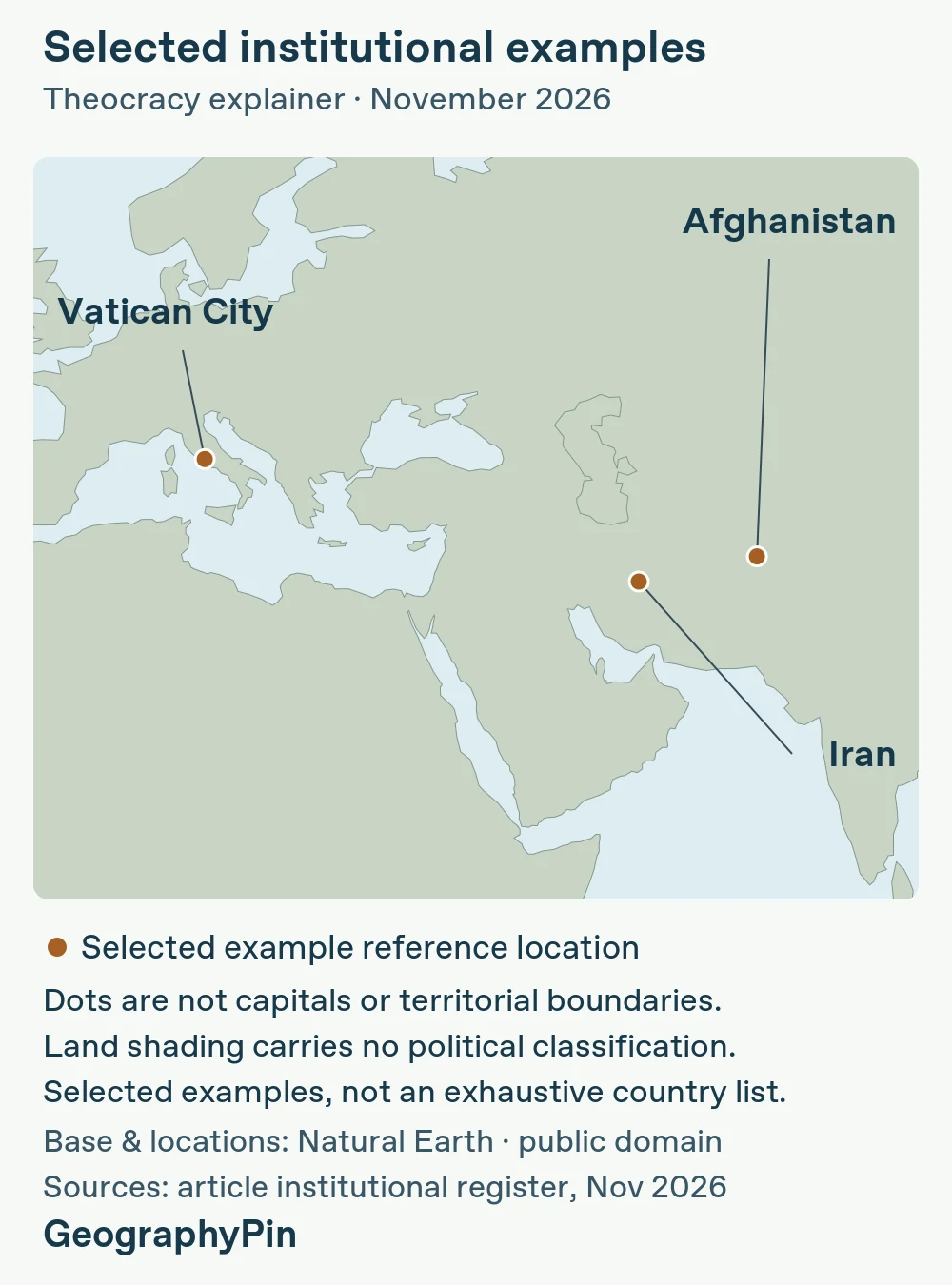
Compare powers rather than treating cases as identical
| Example | Institutional evidence | What the example illustrates | Source and date |
|---|---|---|---|
| Vatican City | The Pope is sovereign and holds legislative, executive and judicial governing power. | Religious office coincides with state sovereignty. | Fundamental Law, July 31, 2026; Article 1. |
| Iran | Guardian Council reviews parliamentary legislation against Islamic criteria and the Constitution. | Elected institutions coexist with religious constitutional oversight. | 1989 constitutional text; current IPU law-making profile. |
| Afghanistan under Taliban de facto rule | A 2026 UN expert communication examines rules signed by the Taliban leader and justified through the authorities’ interpretation of Sharia. | A dated example of de facto religious governance, not a claim about all Islamic law. | UN Special Procedures communication, April 10, 2026. |
Vatican City: a religious sovereign
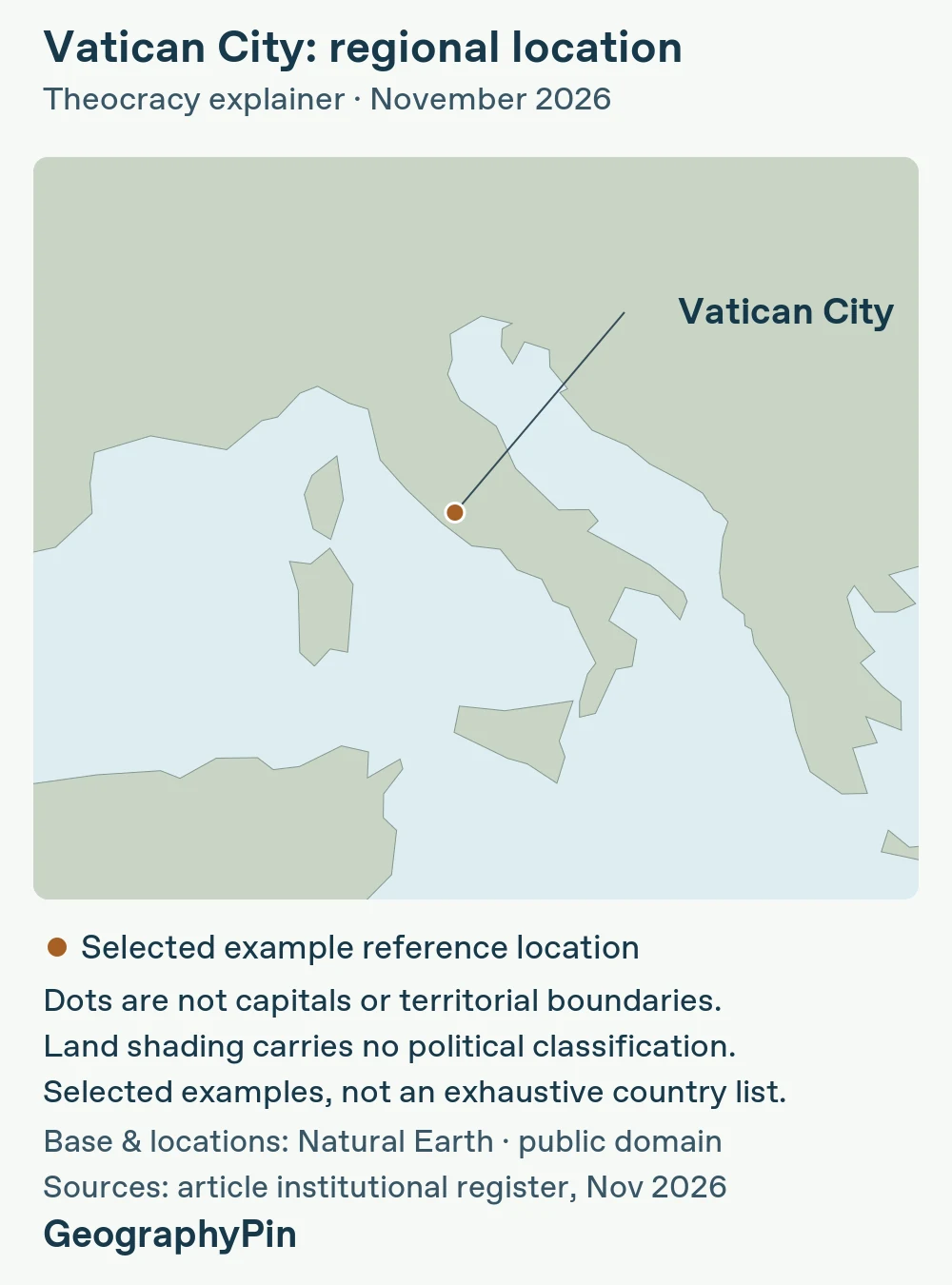
Article 1 of the Fundamental Law of July 31, 2026 places the fullness of legislative, executive, and judicial governing power in the Pope as sovereign. Article 7 provides for a Pontifical Commission exercising legislative functions subject to papal reservations or delegation. The current law replaces the 2023 Fundamental Law; an older summary should not be treated as the latest legal text.
The Holy See’s institutional explanation distinguishes the central authority of the Catholic Church from Vatican City’s territorial state. It also describes papal election by eligible cardinals in conclave. Election within a religious institution should not be confused with a national electorate choosing a government.
Iran: elected offices and religious supervision
Iran’s 1989 constitutional text provides for an elected legislature while placing the branches of government under the Leadership’s supervision. Article 107 assigns selection of the Leader to the Assembly of Experts. Articles 91 and 94 establish the Guardian Council’s composition and review of legislation for compatibility with Islam and the Constitution.
The Inter-Parliamentary Union’s law-making profile describes that review and explains that unresolved disagreements between parliament and the Guardian Council go to the Expediency Council. Calling the system theocratic does not mean that parliament, elections, or other institutions disappear; it identifies the importance of religious authority within the institutional arrangement.
Afghanistan: describe the de facto authorities precisely
A UN Special Procedures communication dated April 10, 2026 examines the Taliban’s criminal rules of courts. The experts describe rules signed by the Taliban leader in January 2026 and justified by the authorities through their interpretation of Sharia. They also say the legislative process outside the de facto authorities was unknown.
This is a specific, dated account of governance, not a comprehensive constitution or a declaration of international recognition. The experts distinguish the authorities’ justification from other Sharia scholars’ criticisms. It would therefore be misleading to portray the Taliban’s rules as the uncontested meaning of Islamic law.
4. A state religion is not the same as clerical government
Denmark provides a useful counterexample to classification by religious wording alone. Section 4 of its Constitutional Act establishes the Evangelical Lutheran Church and provides state support. Yet the same constitutional framework assigns legislative, executive and judicial functions to state institutions, with ministers responsible for government and subject to parliamentary confidence rules.
An established church describes a legally privileged relationship between religion and the state. Religious law describes the source or content of legal rules. Theocracy describes the connection between religious authority and governing power. Those ideas can overlap, but they are not synonyms.
For example, a constitutional reference to religion does not by itself tell us whether religious officials may veto legislation. A religiously influenced family-law rule does not establish who appoints the head of government. Check the actual office, power, and procedure before assigning the broader label.
5. Historical labels need dates and institutional context
The Holy See’s account dates Vatican City State’s creation to the Lateran Treaty of 1929. That modern territorial state should not be treated as an unchanged political entity stretching across the whole history of the papacy. The religious institution and the boundaries of its state are different historical questions.
The same discipline applies when discussing a change of regime elsewhere. Identify the period being described, the evidence for authority during that period, and whether the source is a constitution, a government description, or an observation of actual practice. An old constitutional PDF can remain historically valuable without describing the institutions currently exercising power.
For de facto systems, explain what the evidence establishes and what it does not. Observed control and rule-making do not automatically resolve diplomatic recognition, legal legitimacy, or acceptance by the population. Leaving those questions distinct is more accurate than forcing them into one country label.
What Did We Learn Today?
Theocracy is best understood by tracing authority: who rules, how rulers are selected, and how religious interpretation affects binding decisions. Vatican City, Iran, and the Taliban’s de facto governance illustrate different arrangements, not identical systems. State religion, monarchy, legal recognition, and public belief must be examined separately.
Sources & Data Notes
The examples illustrate institutional arrangements; they are not an exhaustive or officially agreed world list. Constitutional sources establish legal provisions, not every aspect of their implementation. The Afghanistan discussion is limited to the dated UN expert communication cited, which is not a judicial ruling or a diplomatic-recognition decision. Vatican law references use the July 2026 text rather than the superseded 2023 law.
- Vatican City Fundamental Law, July 31, 2026; Articles 1, 7 and replacement provision
- Holy See: Vatican City general information and state structure
- Iran Constitution, revised 1989; primary text reproduced by Constitute, Articles 57, 58, 91, 94 and 107
- WIPO Lex: Iran constitutional version and amendment metadata
- IPU Parline: Iran legislative review and dispute-resolution procedures
- UN Special Procedures, OL OTH 33/2026, April 10, 2026; pp. 1–3
- Danish Parliament: Constitutional Act of 1953, 2019 English publication; Sections 2–4 and 12–15
Maps: GeographyPin, using Natural Earth public-domain data. Reference markers are locators, not legal boundaries or a global classification. Featured image: an original AI-generated GeographyPin editorial illustration of religious authority and public law; it depicts no real building, sacred text or country.