Denmark often enters political arguments as an example of socialism because of its public services and income protections. But those features do not tell the whole story of its businesses, healthcare providers, or wage-setting institutions.
Denmark is better described as a capitalist market economy with an extensive welfare state, not a socialist economy based on replacing private enterprise. Public services, income protection, and collective bargaining coexist with private businesses. Calling the model social democratic describes important institutions; it does not mean the state owns everything.
How to use this article: Compare the main institutions, examine the healthcare example, or see how wages are set.
1. Private business, public services, and negotiated wages coexist
The Danish Ministry of Foreign Affairs’ national website describes Denmark as a capitalist market economy with a strong welfare safety net. This combination is not a contradiction: the way production is owned and organized is different from how society finances services or protects incomes.
Main institutions of the Danish model
| Area | Danish arrangement | What it does not establish |
|---|---|---|
| Businesses | Private enterprise and markets are central to the official economic description. | That government has no economic role. |
| Healthcare | Most services are tax-financed and mainly provided without a charge at use. | That every provider is state-owned or every service is free. |
| Employment terms | Collective agreements set many employment conditions; coverage is not universal. | That the government directly sets every wage. |
| Income protection | Unemployment insurance is voluntary and involves unemployment funds. | That every worker automatically qualifies for identical benefits. |
These distinctions matter more than treating “public” and “private” as two sealed compartments. A business can operate in a market while its employees receive public services and bargain collectively over their pay.
2. Taxes finance services without replacing the market economy
The Danish Patient Safety Authority explains that most healthcare services are financed through general taxation. Public spending pools resources for particular purposes; it does not, by itself, transfer ownership of every business to the public.
The Danish healthcare example: payer and provider differ
The official healthcare overview, updated in June 2026, identifies state, regional, and municipal responsibilities. It also specifically refers to services provided by general practitioners and specialists in private practice. This is a concrete reason not to equate publicly organized healthcare with exclusive state ownership of all medical practices.
Ask three separate questions: who pays, who provides the service, and who regulates it? The answers can involve different institutions. The same distinction helps explain why a publicly financed service is not sufficient evidence that the entire economy is socialist.
Financing also involves choices and constraints. The OECD’s January 2026 survey identified pressure from rising demand for public services and defense spending. It recommended efficiency improvements and spending priorities. Those are dated economic assessments, not proof that every service works perfectly or that welfare provision has no cost.
3. Flexicurity combines job mobility with protection
Workindenmark, the public employment service, describes flexicurity through labor-market flexibility, a welfare system, and active employment policies. The idea concerns protection through economic change, rather than a guarantee that a particular job will last forever.
Who sets wages in Denmark?
There is no statutory national minimum wage. Trade unions and employer organizations negotiate collective agreements that regulate pay and other conditions across much of the labor market. Workindenmark also makes clear that not all jobs are covered; where no agreement applies, terms must be negotiated directly.
Collective bargaining is not the same as government wage-setting or worker ownership of an enterprise. It is a process through which organized workers and employers negotiate conditions while remaining distinct parties.
Nor does flexibility mean there are no employment laws. The official labor-market explanation identifies statutory protections concerning matters such as holidays, employment contracts, and equal treatment. It would therefore be misleading to turn an informal description of easy hiring and dismissal into a claim of unlimited employer discretion.
Consider a hypothetical employee changing employers. The relevant questions include which agreement covers the new role, what the contract provides, and whether the person meets the conditions for income protection between jobs. A national slogan cannot answer those individual questions.
4. Why the socialist label causes confusion
In everyday debate, “socialist” is sometimes used loosely for substantial public services or redistribution. Under a more specific ownership-based definition, those policies do not establish socialism. The Stanford Encyclopedia of Philosophy’s discussion distinguishes socialist institutional proposals from simply treating any government activity as socialist.
Do not turn public-sector statistics into an ideology score
Statistics Denmark’s employee series separates general government from corporations and organizations, describing the latter group as mainly private businesses. “Mainly” matters: the statistical labels are not interchangeable with a perfect public-versus-private ownership split.
Employment shares, spending shares, and asset ownership are also different measures. A statistic about one cannot be relabeled as the percentage of Denmark that is socialist. Use the same definition and period when comparing countries, rather than selecting whichever number fits a political argument.
“Social-democratic welfare state” is useful shorthand for the combination of markets, social protection, and labor institutions. It should not imply that every party, policy, or business follows a single doctrine. GeographyPin’s socialist-country classification guide explains why the definition must come before the country label.
Frequently Asked Questions
Is joining a trade union the same as joining an unemployment fund?
No. Representation in workplace matters and unemployment insurance serve different purposes. An unemployment fund, or a-kasse, may be affiliated with a union, but the institutions and entitlements should not be treated as identical. Workindenmark identifies unemployment insurance as voluntary, so coverage should not be assumed from the existence of a welfare state.
What Did We Learn Today?
Denmark makes more sense when ownership, service financing, and employment institutions are examined separately. Public healthcare financing can coexist with private practice, and collective bargaining can shape wages without replacing employers or markets. Precise institutional descriptions are more useful than turning every public benefit or statistic into a verdict about socialism.
Sources & Data Notes
Sources consulted in November 2026. This explanation compares institutions, not a calculated public-ownership percentage. The OECD assessment is dated January 2026; later official guidance is identified separately. Healthcare and benefit rules depend on eligibility and circumstances; this is an explanation of the system, not an individual entitlement assessment.
- Denmark.dk, Ministry of Foreign Affairs: Doing business in Denmark
- Danish Patient Safety Authority: How the Danish healthcare system works, June 2026
- Workindenmark: The Danish Labour Market, January 2026
- Workindenmark: Labour Rights, January 2026
- Workindenmark: The Danish labour market and terms of employment
- Statistics Denmark: Employees; sector definitions
- OECD Economic Surveys: Denmark 2026, executive summary, January 2026
- Stanford Encyclopedia of Philosophy: Socialism, revised 2024
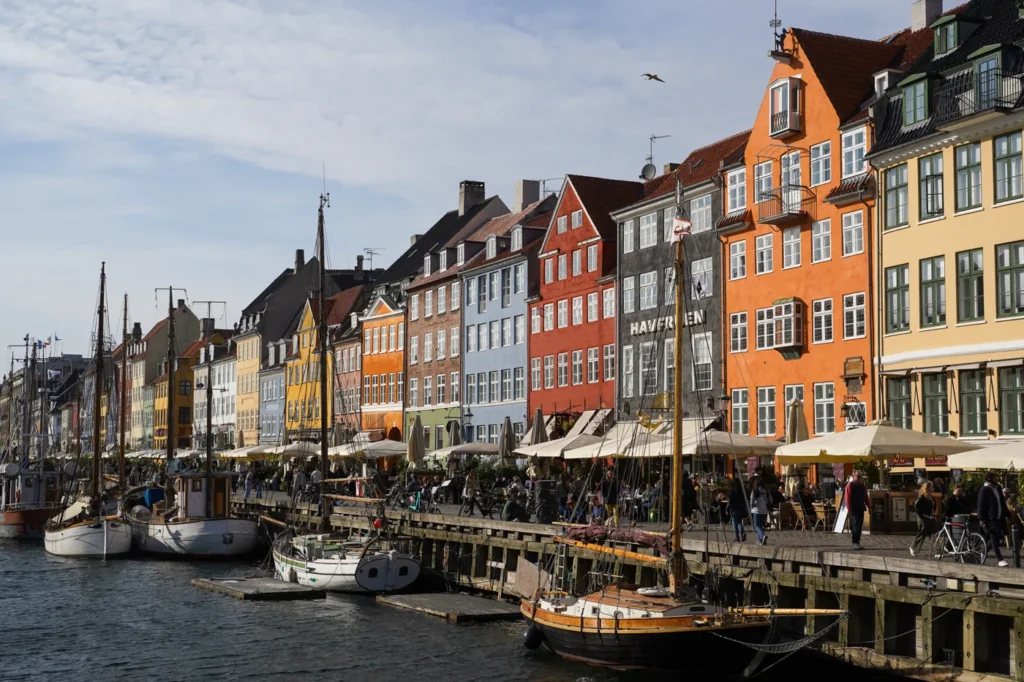
Photo: © Ole Neitzel / Wikimedia Commons, CC BY 4.0; resized and converted to WebP. The photograph shows Nyhavn in Copenhagen on April 10, 2025, and provides geographic context, not evidence of economic ownership or welfare outcomes.
