Cuba’s private businesses can make the question “Is Cuba still communist?” seem harder than it first appears. The key is to separate who holds political authority from which kinds of property and enterprise the law permits.
Yes. Cuba remains a one-party state led by the Communist Party, and its constitution defines a socialist system. Private businesses and economic reforms do not by themselves change that political structure. The constitution recognizes several ownership forms, while recent measures have altered business rules without announcing an end to socialism.
How to use this article: Compare law and political practice, check the ownership categories, or follow the reform timeline.
1. Party leadership and socialist identity
The constitutional answer begins with institutions, not with whether a shop accepts private customers. Article 1 identifies Cuba as a socialist state; Article 5 gives the Communist Party of Cuba a leading role in society and the state. Article 4 declares the socialist system irrevocable. These provisions explain why Cuba remains in GeographyPin’s communist countries list.
Constitutional language and political practice
The 2019 constitutional text, available in English through FAOLEX, also describes movement toward a communist society as an objective. That is different from claiming Cuba has already achieved a classless or stateless society.
Freedom House’s 2026 assessment describes a one-party state that excludes political pluralism and restricts dissent. This is an independent assessment of political practice, distinct from the constitution’s own description of democratic government. Its reporting period principally concerns 2025, not every later event in 2026.
The constitution has not remained wholly untouched since 2019. A July 2025 amendment concerned Article 127’s presidential-age restriction. That change should not be confused with abolishing party leadership or rewriting the ownership categories discussed below.
2. The constitution recognizes several forms of ownership
Article 18 places public ownership of the fundamental means of production and planned economic direction at the center of the socialist system. Article 22 nevertheless recognizes multiple ownership forms. “Communist-party-led” therefore does not mean that every possession or business is state-owned.
The seven categories in Article 22
| Category | Meaning in the constitutional text |
|---|---|
| Socialist property of the whole people | The state represents the people as owner. |
| Cooperative | Joint ownership rooted in members’ collective work and cooperative principles. |
| Political, mass, and social organizations | Assets used for those organizations’ purposes. |
| Private | Specified productive assets owned by Cuban or foreign individuals or legal entities, with a complementary economic role. |
| Mixed | A combination of two or more ownership forms. |
| Institutions and associations | Assets held for nonprofit purposes. |
| Personal | Belongings meeting personal needs rather than functioning as productive assets. |
These are categories, not percentages. The table does not show how much wealth, output, employment, or retail activity each category represents. Those questions require separate statistical evidence. It also does not mean every activity is open to any prospective owner without authorization.
3. A timeline of identity and economic reform
Political identity and business rules have changed on different timelines. The selected milestones below show why neither the revolution nor one later reform is a complete description of today’s economy.
Selected milestones and what they establish
| Date | Milestone and significance |
|---|---|
| April 16, 1961 | Fidel Castro proclaimed the revolution’s socialist character. This is a political declaration, not the date of every later economic institution. |
| 2019 | The new constitution retained party leadership while expressly recognizing private and other property forms. |
| August 2021 | A legal package covered micro, small, and medium enterprises, cooperatives, and self-employment. These categories should not be treated as identical. |
| June 2026 | Prime Minister Manuel Marrero’s parliamentary address presented extensive economic transformations while explicitly maintaining a socialist political direction. |
| July–August 2026 | Officials explained revised nonstate-activity rules; a further commercial-policy briefing described updated trade and registration measures. |
The 2021 package is a historical milestone, not a claim that its original rules remain the final word. Later measures matter when evaluating what businesses may do. Equally, a speech explaining policy direction should not be presented as though it were the complete implementing legislation.
4. What the 2026 reforms do and do not establish
In his June 2026 address, published by the Communist Party newspaper Granma, Marrero framed wider participation by economic actors and the use of market mechanisms as adjustments intended to preserve the socialist project. That is the government’s stated rationale, not an independent verdict on whether the reforms will succeed.
Separate announcements, rules, and results
A July 29, 2026 briefing reported by Granma identified Decree 160 as replacing Decree 107 on prohibited or conditional activities for nonstate actors. The officials described greater scope for participation alongside continuing regulation. That supports the conclusion that the rules are evolving, not that all restrictions have vanished.
The August 28 commercial-policy briefing described Decrees 167 and 168, covering domestic trade and commercial registration. The trade minister emphasized translating the new framework into practice. Simplifying a licensing system and demonstrating that it works effectively are different achievements.
A useful reform check therefore asks three things: what the policy promises, what the applicable rule authorizes, and what reliable evidence shows happening. This article summarizes the direction of change; the official briefings are not substitutes for checking the full operative rules before starting a particular business.
5. Which economic claims need fresh evidence?
Claims about the number of private firms, their share of employment, permitted sectors, or currency access can become outdated quickly. A count of approved enterprises is not necessarily a count of operating enterprises. A share of retail sales is not the same as a share of national output or ownership.
Consider a hypothetical newly authorized shop. Its permit demonstrates that a particular activity is allowed under specified conditions. It does not establish nationwide shortages have ended, that private firms dominate every sector, or that opposition parties can compete for power. Each claim needs its own evidence.
Cuba can thus be described as communist-party-led and constitutionally socialist while allowing private economic activity. These labels answer different questions. The broader distinction is explained in GeographyPin’s socialist-country classification guide; Cuba’s specific arrangements must be judged from Cuban law and practice rather than a stereotype.
Frequently Asked Questions
Does “mixed ownership” simply mean foreign ownership?
No. Article 22 defines mixed property by combining ownership forms, not by the owner’s nationality alone. To understand a specific enterprise, distinguish its owners, the legal arrangement joining them, and the permissions governing its activities.
What Did We Learn Today?
Cuba’s political structure and its business rules are separate parts of the answer. Multiple ownership forms and evolving regulations do not automatically replace party leadership. Understanding the country means reading legal categories carefully, dating reform claims, and distinguishing a policy’s stated aims from its implementation and measurable results.
Sources & Data Notes
Evidence reviewed in November 2026. Constitutional categories use the 2019 text, with the later Article 127 amendment identified separately; the FAO-hosted English translation is not a new consolidated 2026 constitution. Granma is the Communist Party’s official newspaper: speeches and institutional briefings document stated policies, not independent proof of outcomes. Detailed 2026 operating permissions require the relevant legal text, not this overview.
- FAOLEX: Cuba’s 2019 Constitution, Comparative Constitutions Project English text; Articles 1, 4, 5, 18, and 22
- Freedom House: Cuba, Freedom in the World 2026; primarily covering 2025
- Granma: July 2025 constitutional amendment concerning Article 127
- Granma: April 1961 proclamation of the revolution’s socialist character
- Granma: August 2021 legal package for economic actors
- Manuel Marrero Cruz: parliamentary address, published by Granma in June 2026
- Granma: July 2026 official briefing on nonstate economic activities
- Granma: August 2026 official briefing on trade and commercial registration
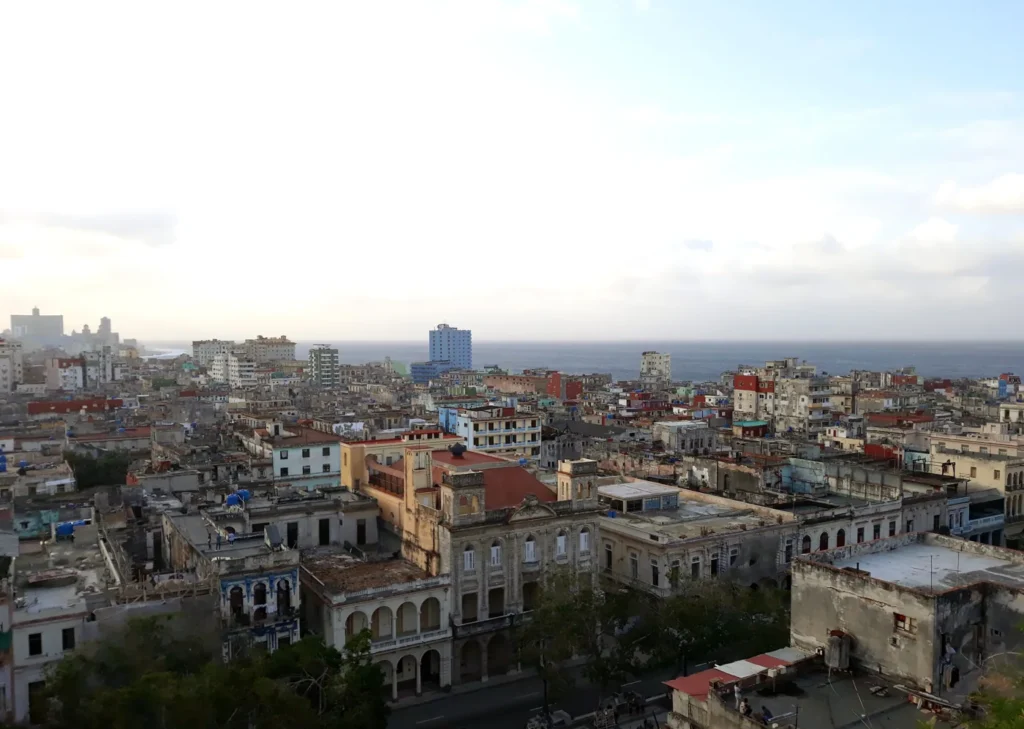
Photo: acediscovery / Wikimedia Commons, CC BY 4.0; resized and converted to WebP. Photographed in Havana on January 27, 2018. The cityscape provides geographic context, not evidence of current business ownership, economic conditions, or reform outcomes.
