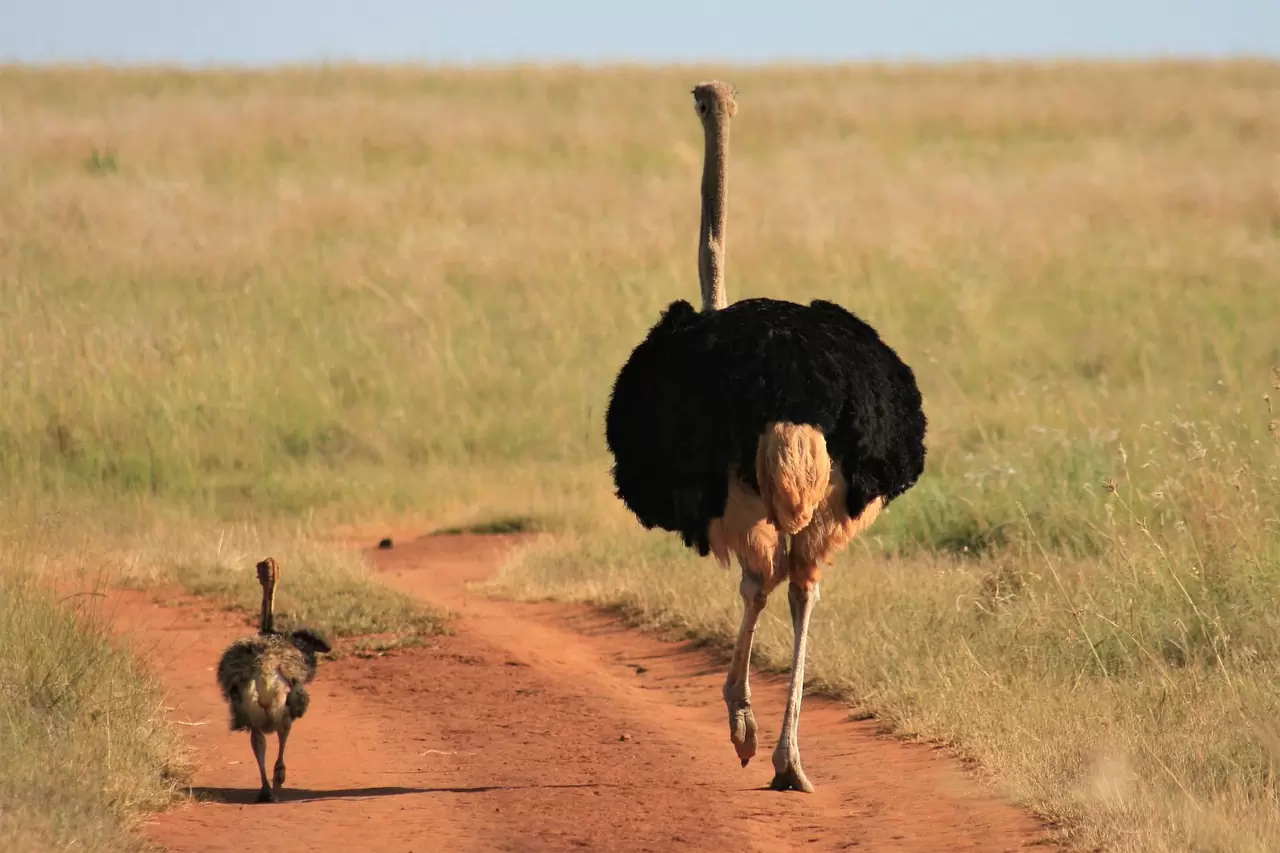
The common ostrich is the biggest living bird in the world by both mass and height, reaching about 9 feet (2.7 meters) and commonly weighing 200–300 pounds (90–136 kilograms). The wandering albatross has the widest wingspan among living birds, while extinct elephant birds were much heavier than any bird alive today.
How to use this article: Start with the record table, check the ostrich’s measured size, see why fossil estimates vary, or go straight to the heaviest extinct birds.
What Does “Biggest Bird” Mean?
In everyday language, “biggest” usually means the largest overall body. For living birds, that makes mass and standing height the most useful measures. Wingspan is a separate record: a long-winged seabird can span far more from tip to tip while weighing only a fraction as much as a large flightless bird.
Which bird holds each size record?
| Category | Record holder | Best-supported scale |
|---|---|---|
| Largest living bird by mass and height | Common ostrich (Struthio camelus) | Adults about 200–300 pounds (90–136 kilograms); up to 9 feet (2.7 meters) tall |
| Widest wingspan among living birds | Wandering albatross (Diomedea exulans) | About 11.5 feet (3.5 meters); documented individual record of 11 feet 11 inches (3.63 meters) |
| Widest estimated wingspan of a known bird | Pelagornis sandersi | Estimated at 19.9–24.2 feet (6.06–7.38 meters), with a conservative estimate near 21 feet (6.4 meters) |
| Heaviest known flying bird | Argentavis magnificens | Estimated at 154–159 pounds (70–72 kilograms) |
| Heaviest known bird lineage | Madagascar’s elephant birds | Several hundred kilograms; the upper estimate and exact species label depend on the fossil model and taxonomy used |
The table separates records that are often collapsed into one claim. It also distinguishes measurements taken from living animals from estimates inferred from fossil bones or eggshells.
The Largest Living Bird by Mass: The Common Ostrich
The common ostrich (Struthio camelus) is both the tallest and the heaviest living bird. It is native to open habitats in Africa and is completely flightless, but its long, powerful legs make it an exceptionally capable runner.
How large is a common ostrich?
Smithsonian’s National Zoo gives an adult weight range of 200–300 pounds (90–136 kilograms) and a maximum standing height of about 9 feet (2.7 meters). Males are generally larger than females, so record-sized birds are usually adult males.
Published figures vary at the upper end, and some reference compilations report exceptional individuals above 300 pounds (136 kilograms). Those values should not be treated as a normal adult weight; the Smithsonian range is the clearer basis for a general size comparison.
Why can’t the largest living bird fly?
Ostriches have evolved around movement on the ground rather than powered flight. Their heavy bodies, reduced flight apparatus, and muscular legs are suited to running, while their wings help with balance, turning, displays, and temperature control. Large body size alone does not explain every flightless bird, but it is part of the ostrich’s specialized ground-running form.
Largest Birds by Wingspan: Wandering Albatross
The wandering albatross (Diomedea exulans) holds a different living record: the greatest wingspan. Its long, narrow wings are adapted to efficient gliding over the Southern Ocean, allowing the bird to remain airborne without the rapid, continuous wingbeats used by many smaller birds.
How wide are a wandering albatross’s wings?
Smithsonian Ocean gives the species a wingspan of about 11.5 feet (3.5 meters). Guinness World Records documents a male measured in 1965 at 11 feet 11 inches (3.63 meters) from wingtip to wingtip.
Those numbers serve different purposes: 11.5 feet is a rounded species figure, while 11 feet 11 inches describes an exceptional measured individual. The older article’s 12-foot figure was a reasonable rounding, but 11 feet 11 inches is the more precise documented record.
Why wingspan is not the same as overall size
The albatross extends farther sideways than an ostrich is tall, but it does not approach an ostrich in body mass. Calling it the “largest flying bird” is therefore incomplete unless the comparison specifically means wingspan. This distinction also matters when extinct flying birds are compared.
Largest Birds in History: Extinct Flying Giants
The fossil record adds two separate flying-bird records. Pelagornis sandersi is the leading candidate for the widest wingspan, while Argentavis magnificens is the leading candidate for the greatest body mass among birds capable of flight.
Pelagornis sandersi: the widest known bird wings
A 2014 study in the Proceedings of the National Academy of Sciences estimated a wingspan of 19.9–24.2 feet (6.06–7.38 meters), with a conservative reconstruction near 21 feet (6.4 meters). Its estimated mass was much lower than its wings suggested: roughly 48–88 pounds (21.9–40.1 kilograms).
The combination of an extremely long wing skeleton and relatively low estimated mass supports the interpretation of a specialized soaring bird. The estimate is roughly twice the wingspan of a wandering albatross, although it comes from a fossil reconstruction rather than a living bird measured tip to tip.
Argentavis magnificens: the heaviest known flying bird
Argentavis magnificens is estimated to have weighed about 154–159 pounds (70–72 kilograms). A 2007 aerodynamic study modeled a wingspan near 23 feet (7 meters), while the later comparisons used in the 2014 Pelagornis study placed it around 16.7–21.3 feet (5.09–6.5 meters).
The span depends on the reconstruction method, but the mass distinction remains useful: Argentavis was substantially heavier than Pelagornis sandersi. That is why one species can hold the mass record for flying birds while the other holds the wingspan record.
Why extinct-bird measurements vary
Fossils rarely preserve a complete bird with its feathers in place. Researchers estimate total dimensions by scaling preserved bones, comparing related species, and testing possible body proportions. Different models can produce different wingspans or masses, especially for animals whose proportions extend beyond those of living comparison species. Fossil figures should therefore be read as evidence-based ranges, not tape-measure results.
The Heaviest Birds Ever: Elephant Birds and Thunder Birds
Flightless land birds could become far heavier than any flying species. Madagascar’s elephant birds and Australia’s dromornithids—often called thunder birds or mihirungs—include the strongest candidates for the greatest body mass in bird history.
Which extinct bird was the heaviest?
A 2018 Royal Society Open Science study classified the largest elephant-bird specimens as Vorombe titan and estimated a mean body mass of about 1,417 pounds (642.9 kilograms). The bird stood around 9 feet 10 inches (3 meters) tall, and some individual estimates were higher.
The species name is not fully settled. A 2023 ancient-DNA and eggshell study questioned whether the three-genus framework cleanly represents elephant-bird species boundaries. It associated extreme body size of roughly 1,540–2,200 pounds (700–1,000 kilograms) with Aepyornis maximus, but the model carried substantial uncertainty and the authors called for another taxonomic revision.
The most responsible all-time answer is therefore Madagascar’s elephant birds as a group. Calling either Vorombe titan or Aepyornis maximus the undisputed single record holder gives more certainty than the fossil and genetic evidence currently allows.
Dromornis stirtoni: Australia’s giant competitor
Dromornis stirtoni was a massive flightless bird that lived in Australia. The Australian Museum gives a height above 9 feet 10 inches (3 meters) and a mass of about 992–1,102 pounds (450–500 kilograms). A Flinders University research summary reported an average near 1,058 pounds (480 kilograms), with some males possibly exceeding 1,323 pounds (600 kilograms), showing how strongly the answer depends on the specimen and method.
That makes Dromornis one of the heaviest birds known, but the old flat estimate of 1,800 pounds (800 kilograms) should not be presented as settled. Current evidence more clearly supports elephant birds as the all-time mass leaders, with Dromornis stirtoni remaining an important contender in the broader comparison.
Frequently Asked Questions
What is the biggest bird in the world today?
The common ostrich is the biggest living bird by both body mass and standing height. Adults commonly weigh 200–300 pounds (90–136 kilograms) and can stand about 9 feet (2.7 meters) tall.
Can the world’s biggest living bird fly?
No. The common ostrich is flightless and is adapted for fast movement on the ground. Its wings assist with balance, maneuvering, displays, and care of its young rather than flight.
Is a wandering albatross bigger than an ostrich?
Only by wingspan. A wandering albatross has much wider wings, but an ostrich is far heavier and taller. The answer changes depending on whether “bigger” means wingspan or overall body size.
What was the biggest bird ever?
Madagascar’s extinct elephant birds are the best-supported answer by body mass. The exact species name and maximum weight remain debated because fossil-based mass estimates and elephant-bird taxonomy have changed.
Which bird had the largest wingspan ever?
Pelagornis sandersi has the widest scientifically estimated wingspan of any known bird, at roughly 19.9–24.2 feet (6.06–7.38 meters). It is known from fossils, so this is a reconstructed range rather than a direct measurement.
What Did We Learn Today?
The common ostrich is the biggest living bird by mass and height, while the wandering albatross leads living birds by wingspan. In the fossil record, Pelagornis sandersi had the widest estimated wings, Argentavis magnificens was the heaviest known flyer, and Madagascar’s elephant birds reached the greatest overall mass—though their exact species labels and upper weights remain under scientific review.
Sources & Data Notes
Living-bird measurements were checked against Smithsonian’s National Zoo, Smithsonian Ocean, and Guinness World Records; fossil comparisons draw principally on studies published in the Proceedings of the National Academy of Sciences, Royal Society Open Science, and Nature Communications, with Australian Museum and Flinders University material used for Dromornis. Living measurements are rounded ranges, while fossil masses and wingspans are estimates shaped by the available specimens, reconstruction method, and taxonomic convention. This article was prepared and editorially reviewed by Z.K. Atlas, who completed the final factual checks and publication approval. AI tools may have assisted during the editorial process, including with language refinement and the creation or editing of visual materials.