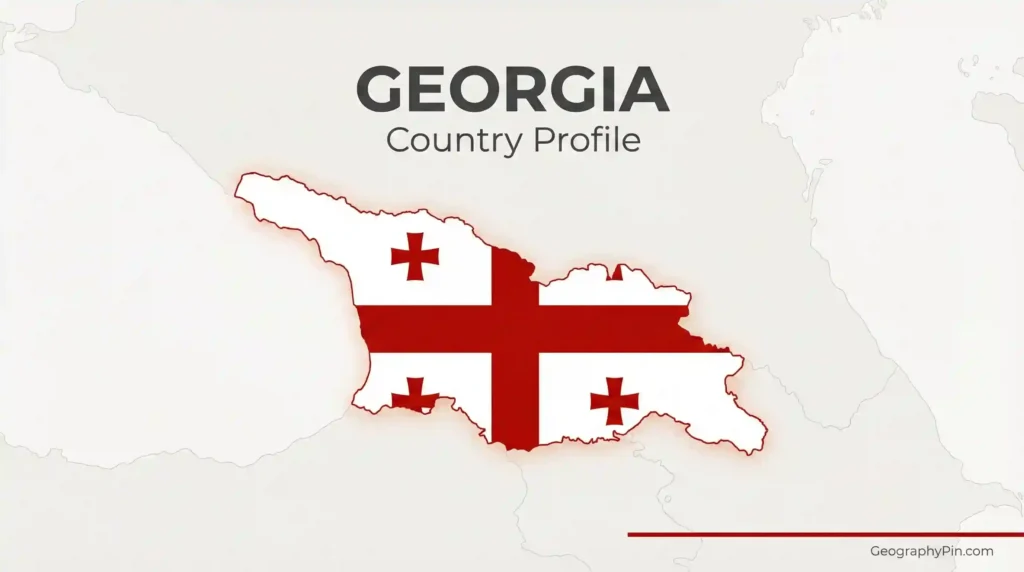
If you’re looking for a clear, all-in-one Georgia country profile – about the country (Sakartvelo), not the U.S. state – this page brings together the key facts on its map, people, economy, politics, history and travel highlights.
Georgia is a small country in the South Caucasus, between Eastern Europe and Western Asia. Its capital is Tbilisi, it covers about 69,700 km² (26,900 sq mi) and has roughly 3.9 million people. Georgia is known for its Caucasus mountains, very old wine-making traditions and a strategic location on Black Sea–Eurasia routes.
Quick Facts & Key Numbers for the Georgia Country Profile
Georgia is a compact South Caucasus country on the eastern shore of the Black Sea. It covers about 69,700 square kilometres (26,900 square miles) and has a population of roughly 3.9 million people, according to preliminary 2024 census data released in 2025. Most people live in cities such as Tbilisi, Batumi and Kutaisi, while many highland areas remain sparsely populated.
Georgians call their country Sakartvelo (საქართველო), while “Georgia” is the English name. The official language is Georgian, written in its own script, and the national currency is the Georgian lari (GEL). The country uses Georgia Standard Time, which is UTC+4 hours, without daylight saving time.
How to use this profile: Students can start with Quick Facts and History in Brief. Travellers may want to jump to Cities, Regions & Travel Highlights. Policy-curious readers should focus on Government & Politics, Economy and Challenges & Future Trends.
- World Bank income group: Upper-middle-income economy (2024).
- Human Development Index (HDI): 0.844 in 2023, ranked 57th out of 193 countries and territories (“very high human development”).
- Data note: Most figures in this Georgia country profile use sources updated between 2023 and 2025; exact values can vary slightly by source and method.
| Metric | Value |
|---|---|
| Official country name | Georgia (local name: Sakartvelo / საქართველო) |
| Capital city | Tbilisi |
| Largest city | Tbilisi |
| Population (2024 census, preliminary) | ≈ 3.914 million residents (excluding Abkhazia and South Ossetia) |
| Area | ≈ 69,700 km² (≈ 26,900 sq mi) |
| Population density | ≈ 56 people per km² (≈ 145 per sq mi) |
| Demonym | Georgian(s) |
| Official language | Georgian |
| Main religion | Predominantly Georgian Orthodox Christianity |
| Currency | Georgian lari (GEL) |
| Government type | Unitary parliamentary republic |
| Independence | Independence restored 1991 (from the USSR) |
| Continent / region | South Caucasus, at the crossroads of Eastern Europe and Western Asia |
| National day | 26 May – Independence Day |
| Time zone(s) | UTC+4 (Georgia Standard Time) |
| Neighbouring countries | Russia, Turkey, Armenia, Azerbaijan; Black Sea to the west |
| Calling code / Internet TLD / ISO code | +995 / .ge / ISO alpha-2: GE |
Where Is Georgia Located?
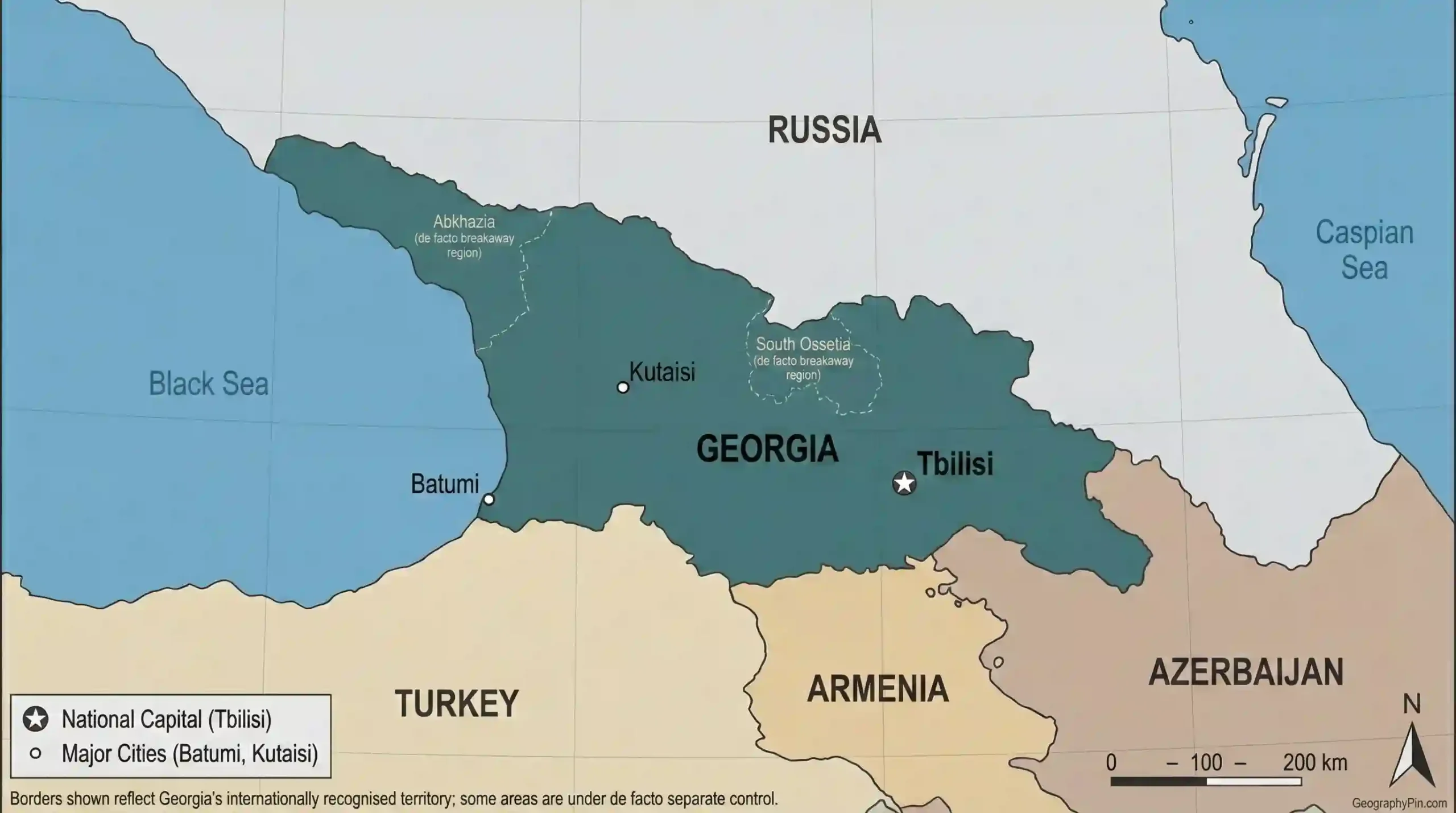
Georgia is located in the South Caucasus, a region that links the eastern shore of the Black Sea to the Caspian basin. On a mental map, it lies south of Russia, north of Turkey, and between Armenia and Azerbaijan. The country’s Black Sea coastline stretches for roughly 310 kilometres (about 190 miles), with lowlands along the coast and higher lands rising quickly inland.
Tbilisi, the capital, sits in the valley of the Mtkvari (Kura) River, roughly in the eastern half of the country. To the north, the Greater Caucasus mountain chain forms a dramatic natural barrier with Russia. To the south, lower ranges and plateaus connect Georgia to eastern Turkey, Armenia and Azerbaijan, making it a key overland corridor between Europe and western Asia.
A very common question is whether Georgia belongs to Europe or Asia. The answer depends on whether we talk about geography or politics:
- Geographic line: Many geographers place the Europe–Asia boundary along the crest of the Greater Caucasus, which would technically put most of Georgia in Western Asia.
- Political and cultural alignment: Georgia is a member of European organisations such as the Council of Europe and has EU candidate status, so it is often grouped with Europe in political discussions.
- Practical takeaway: The safest description is that Georgia is a trans-continental South Caucasus country at the crossroads of Eastern Europe and Western Asia.
Landscapes, Climate & Nature
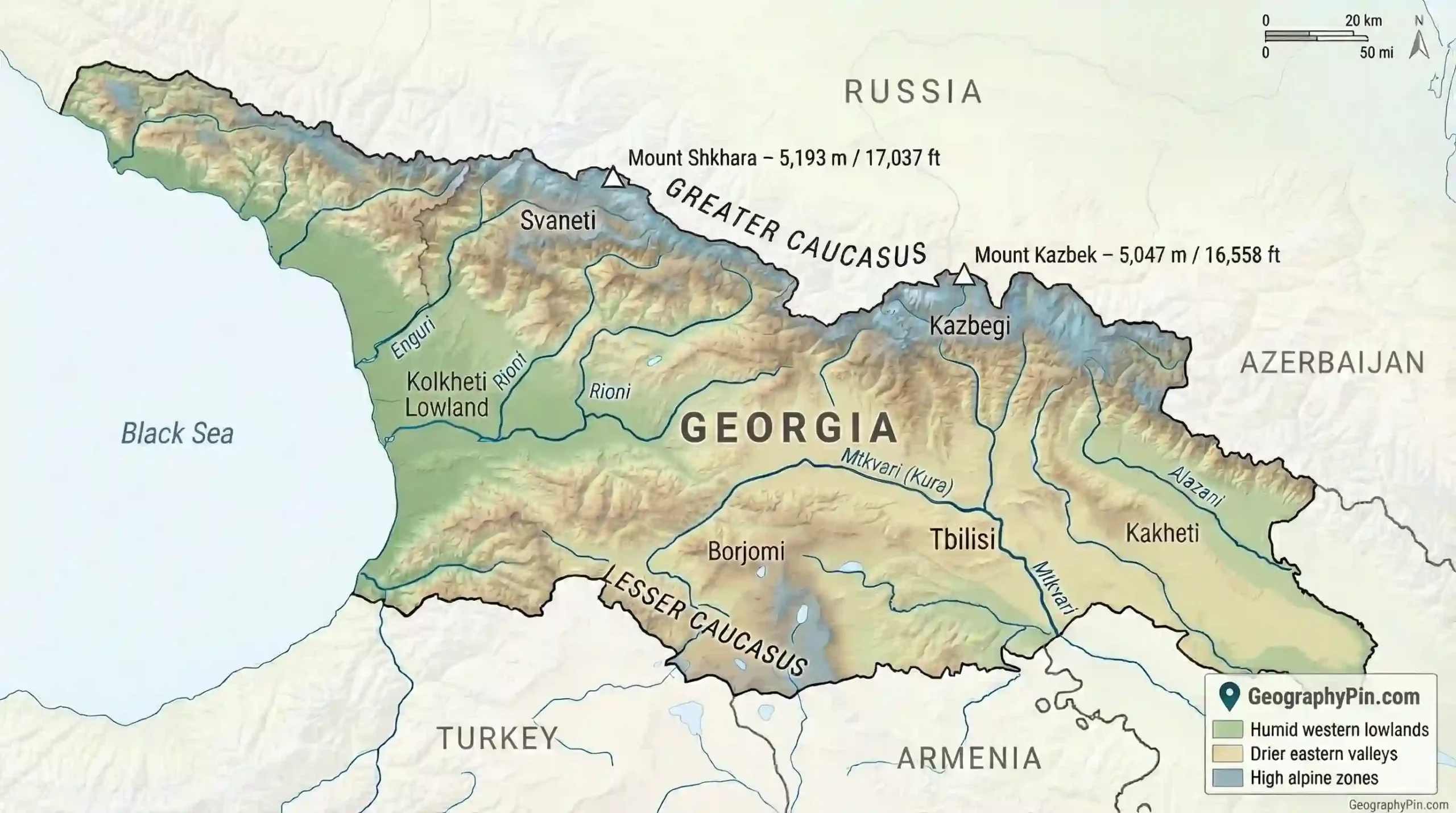
Despite its small area, Georgia has very varied landscapes. The northern border is dominated by the Greater Caucasus, with peaks such as Mount Shkhara rising to about 5,200 metres (around 17,000 feet). Deep river valleys cut through these ranges, creating famous alpine regions like Svaneti, Kazbegi and Racha. In the south, the Lesser Caucasus and volcanic plateaus create lower but still rugged terrain.
Between the mountains and the Black Sea, the Kolkheti lowlands form a humid plain that has long supported agriculture and settlements, including the city of Kutaisi. Eastern Georgia combines drier river valleys, foothills and semi-arid steppe. The main river, the Mtkvari (Kura), flows for roughly 1,360 kilometres (about 845 miles) from Turkey through Georgia into Azerbaijan, shaping many of the country’s largest towns.
The climate also changes quickly across short distances. The Black Sea coast and western lowlands have a humid subtropical climate with mild winters and hot, often humid summers. Eastern Georgia is more continental, with colder winters and hotter, drier summers. In Tbilisi, average January temperatures are a few degrees above freezing (about 2–6°C or 36–43°F), while summer highs often reach 30–32°C (86–90°F). In the high Caucasus, winters are long and very snowy, and even summer nights can be cool.
Forests, alpine meadows and wetlands support rich biodiversity, including brown bears, wolves and many bird species. At the same time, deforestation, soil erosion, glacier retreat, and more frequent landslides and floods are serious environmental concerns. Many of these problems are linked to land use practices and the wider effects of climate change.
Major Rivers, Mountains & Natural Regions
Several large rivers shape Georgia’s geography. The Mtkvari (Kura) crosses the country from west to east, while the Rioni drains western Georgia into the Black Sea. Other important rivers include the Enguri and Tergi (Terek) in the north and the Alazani in the wine-growing Alazani Valley near the border with Azerbaijan.
The highest peaks are in the central Greater Caucasus, including Mount Shkhara (around 5,200 metres / 17,000 feet) and Mount Kazbek (around 5,050 metres / 16,570 feet). Key natural regions include the snowy Svaneti and Kazbegi ranges, the forested Borjomi area, the Kolkheti wetlands near the Black Sea, and the drier steppe and semi-desert landscapes of Kakheti and Kvemo Kartli. National parks and protected areas have expanded in recent years, but many habitats still face pressure from development and climate shifts.
People, Languages & Culture
Georgia’s population is relatively small but diverse. Preliminary 2024 census results suggest about 3.914 million residents, excluding the occupied territories, with just over half living in cities. Tbilisi alone holds roughly one-third of the population. At the same time, many mountain villages and rural areas have lost residents to internal migration or emigration abroad in recent decades.
Ethnic Georgians form a clear majority, alongside Armenian, Azerbaijani and other minorities, including small communities of Greeks, Ossetians and others. A recent feature of the population is a marked increase in foreign residents, including people from Russia and neighbouring countries. Census data indicate that foreign citizens now account for about 6.6 percent of residents, while Georgian citizens make up at least 93.4 percent of the total population.
The state language is Georgian, written in its unique script with its own alphabet. Russian is still widely understood, especially among older generations, and English usage is growing fast in cities, tourism and business. In some regions, Armenian and Azerbaijani are widely spoken in everyday life. Visitors can get by with English in major cities, but learning a few Georgian phrases is appreciated.
Religion plays an important social role. Most citizens belong to the Georgian Orthodox Church, while there are also Muslim, Armenian Apostolic and other Christian communities. Everyday culture features long shared meals called supra, where a toastmaster (tamada) leads structured toasts. Georgian cuisine is known for dishes like khinkali (dumplings), khachapuri (cheese-filled bread) and rich vegetable plates with walnuts and herbs, while polyphonic singing and folk dances remain strong symbols of identity. Modern Georgian culture blends these traditions with contemporary music, film and literature.
Government, Politics & International Role
Political System & Constitution
Georgia is a unitary parliamentary republic. The constitution gives most executive power to the government, led by a prime minister chosen from the parliamentary majority. The president serves as head of state with more limited powers, representing the country abroad and acting as a constitutional figurehead. Parliament is elected through a mixed proportional system, and political competition has often been sharp, with frequent protests and strong civil society involvement.
Regions, Autonomous Areas & Occupied Territories
Administratively, Georgia is divided into regions, municipalities and the capital city of Tbilisi. Two areas, Abkhazia and South Ossetia/Tskhinvali Region, have been outside effective Georgian government control since conflicts in the early 1990s and the 2008 war. Russia recognises them as independent states and maintains a military presence there, while Georgia and most of the international community see them as Georgian territories under occupation. This reality shapes defence policy, internal politics and relations with neighbours.
International Organisations & EU / NATO Path
Georgia is a member of major international organisations, including:
- The United Nations (UN)
- The Council of Europe and the OSCE
- The World Trade Organization (WTO)
- Regional groups such as GUAM (with Ukraine, Azerbaijan and Moldova) and the Black Sea Economic Cooperation (BSEC)
Georgia signed an Association Agreement and Deep and Comprehensive Free Trade Area (DCFTA) with the European Union and was granted EU candidate status in 2023. However, after the adoption of the Law on Transparency of Foreign Influence in May 2024, EU officials stated that Georgia’s accession process was effectively frozen and some financial support was halted. In late 2024, the Georgian government itself announced that it would not pursue accession talks until 2028, further slowing the process.
Security, NATO and Relations with Russia
Georgia has long sought closer security ties with NATO and cooperates with the alliance through joint exercises and missions, but it is not a member and has unresolved territorial disputes. Relations with Russia remain tense, shaped by the 2008 war, continued military presence in Abkhazia and South Ossetia, and periodic borderisation incidents along the occupation lines. At the same time, economic and people-to-people links, including trade and labour migration, create a complex mixture of dependence and mistrust in this part of the South Caucasus.
Domestic politics since 2024 have been strongly influenced by controversial “foreign influence” and “foreign agents” laws. The Law on Transparency of Foreign Influence was adopted in May 2024 despite large protests and international criticism, and a broader Foreign Agents Registration Act took effect in May 2025. Critics argue that these laws threaten media freedom and civil society and pull Georgia away from European democratic standards. Supporters say they increase transparency of foreign funding. How this balance evolves will shape Georgia’s international role in the coming years.
Economy & Key Industries
Overall Size & Income Level
Georgia has a small but open economy. In 2024, nominal GDP was around 33.8 billion US dollars, and GDP per capita was roughly 9,200 US dollars. In purchasing-power terms, GDP per person was about 25,000 international dollars, reflecting lower local prices than in Western Europe. The World Bank classifies Georgia as an upper-middle-income economy, and growth in recent years has often been stronger than the European average, though also sensitive to external shocks.
Main Sectors of the Economy
Services dominate the economy, including trade, transport, tourism, finance and real estate. Manufacturing covers areas such as food processing, metals, chemicals and light industry. Agriculture still provides livelihoods for many rural households, with key products including grapes and wine, hazelnuts, fruits, vegetables and livestock. Structural reforms since the 2000s have simplified taxes and regulations, but productivity gaps remain between modern sectors and more traditional rural activities.
Tourism, Transit & Remittances
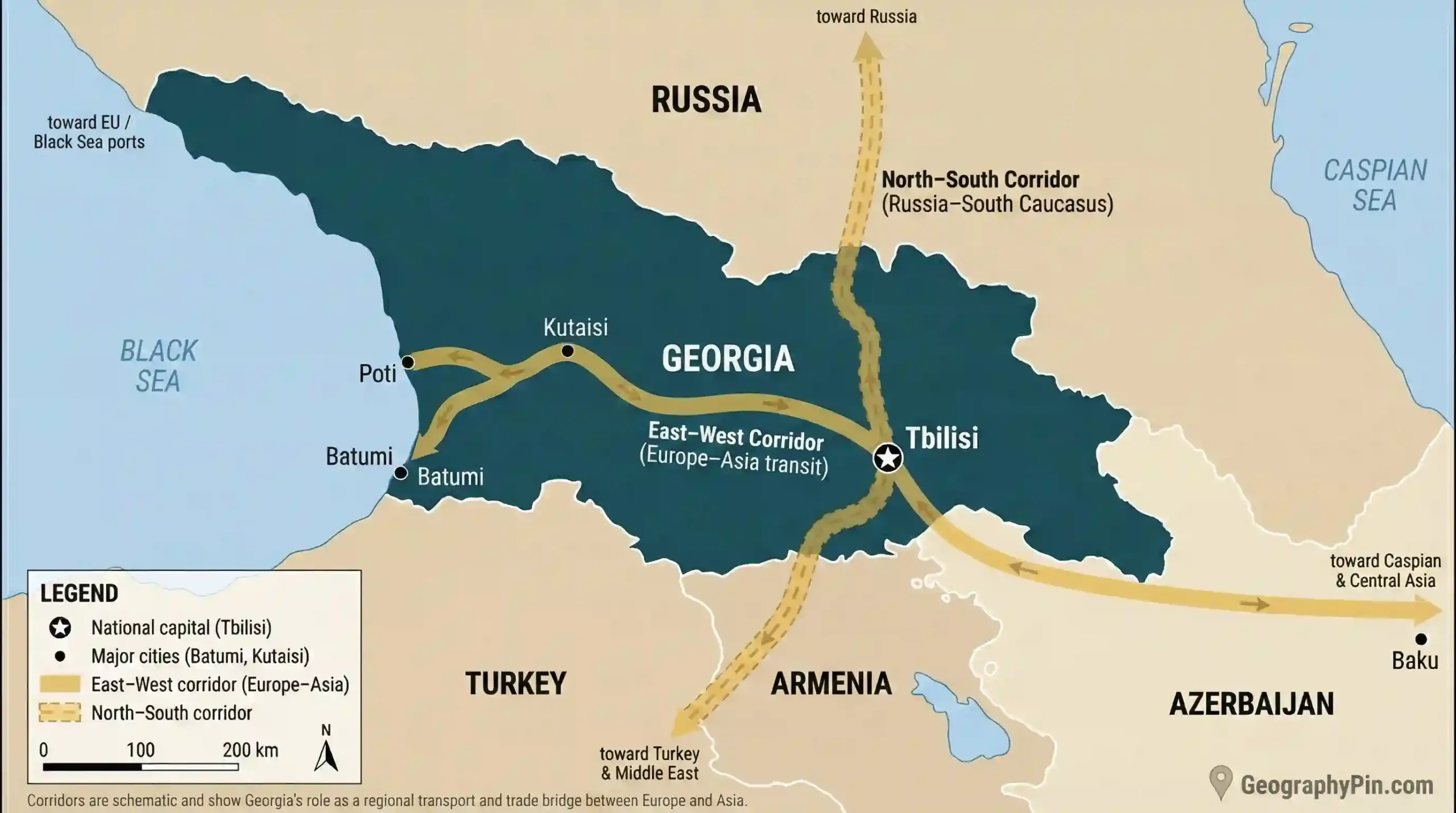
Tourism has become a major source of income and jobs. Before global disruptions, millions of international visitors came each year for mountains, wine regions, historic towns and the Black Sea coast. Georgia also positions itself as a transit hub between Europe and Asia, with pipelines, roads and railways linking the Caspian Sea and Central Asia to Black Sea ports and further west.
Remittances from citizens working abroad are another important pillar. In recent years they have accounted for around 12–15 percent of GDP, including about 14.7 percent in 2023 and roughly 12 percent in 2024. This helps many households but also shows how dependent incomes can be on external labour markets and exchange rates.
Trade, Exports & Main Partners
Georgia trades widely, with both imports and exports large relative to the size of its economy. Important export items include copper ores and concentrates, ferroalloys, re-exported motor vehicles, wine, mineral water and agricultural products such as hazelnuts. Major imports include petroleum products, gas, machinery, vehicles and wheat.
The European Union is among Georgia’s largest trading partners, alongside Turkey, Russia, China and neighbouring South Caucasus states. Free trade agreements and low tariffs support this pattern, but a persistent trade deficit means that services exports, tourism income and remittances are needed to balance the external accounts.
Living Standards, Inequality & Jobs
Georgia’s HDI of 0.844 places it in the “very high” human development group, but not all citizens feel this equally. Unemployment remains in the low double digits, many jobs are informal, and wages in rural areas are often lower than in Tbilisi and a few other cities. Income inequality and regional gaps in services such as healthcare and education remain important policy concerns.
For many young people, a key challenge is finding stable, well-paid work at home rather than leaving for jobs abroad. Future growth will need to focus on higher value-added sectors, better education and training, and reliable institutions that encourage long-term investment.
Cities, Regions & Travel Highlights
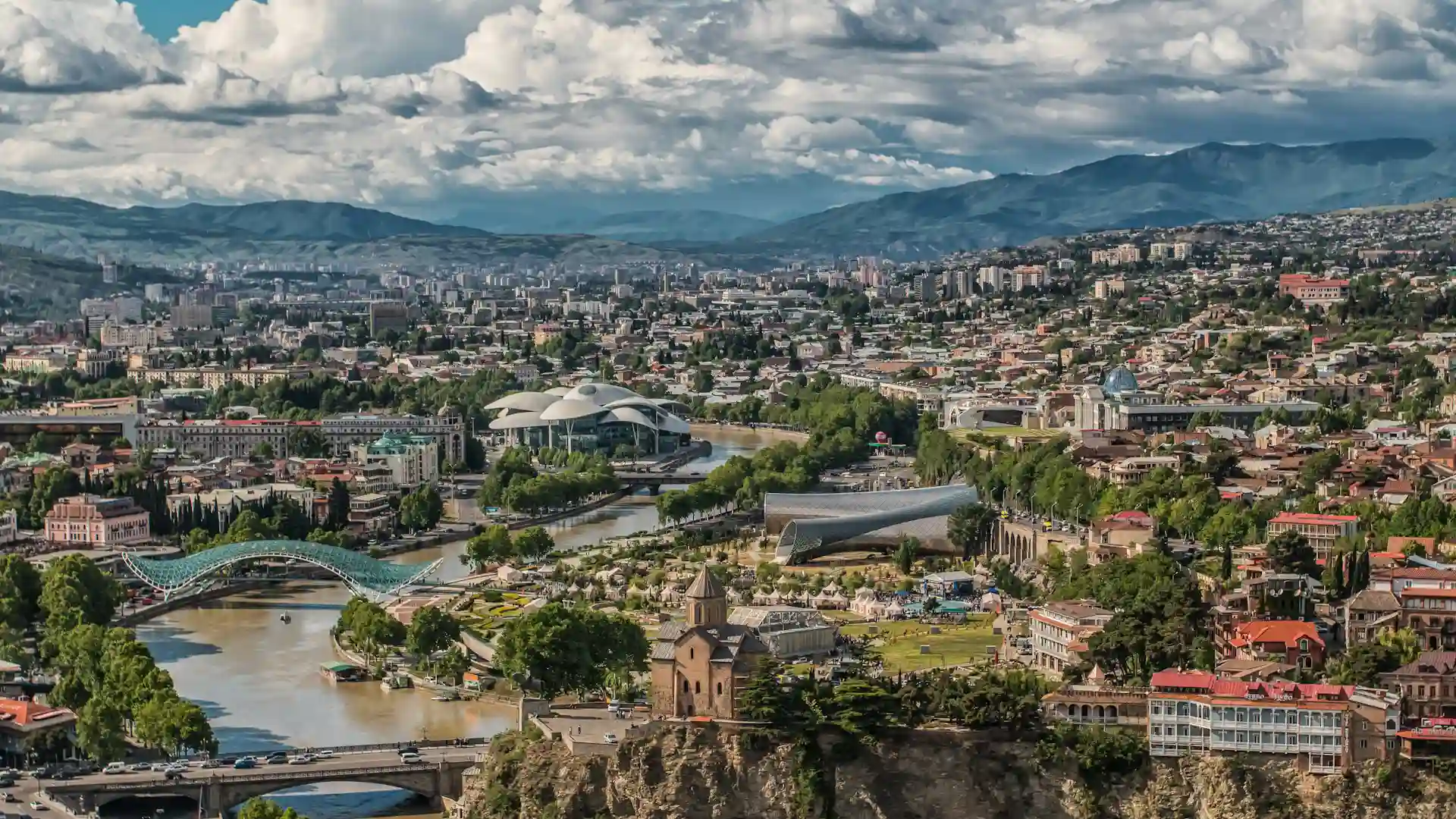
Tbilisi is Georgia’s political, economic and cultural centre. The city stretches along the Mtkvari River, with a mix of 19th-century houses, Soviet-era neighbourhoods and new glass-and-steel developments. Its old town churches, sulphur baths and lively café streets make it the main starting point for visitors, and most national institutions and companies are based there.
On the Black Sea, Batumi is a major port and resort city with modern high-rises along the waterfront and older quarters inland. Kutaisi, in western Georgia, has an important historical role as a former royal capital and sits near caves, waterfalls and protected forests. Rustavi and other industrial towns show the legacy of Soviet-era development, while many smaller towns serve as regional service centres.
The highland regions are among Georgia’s best-known travel areas. Svaneti, with villages such as Mestia and Ushguli, offers medieval tower houses and hiking routes below peaks over 4,000 metres (13,100 feet). Kazbegi (Stepantsminda) in the north is famous for the silhouette of Gergeti Trinity Church above the valley. The wine region of Kakheti, especially the Alazani Valley, combines vineyards, monasteries and views of the Greater Caucasus, while areas like Tusheti remain very remote and accessible only in certain seasons.
- Key takeaways for travellers:
- Expect modern services in Tbilisi and Batumi but more basic infrastructure in many highland villages.
- Winter roads and mountain passes can close due to snow and ice; always check local conditions.
- For a first visit, combining Tbilisi, a wine region and one mountain area gives a good overview of Georgia’s landscapes and culture.
History in Brief
Human settlement in what is now Georgia goes back thousands of years. In antiquity, the western region of Colchis and the eastern kingdom of Iberia appeared in Greek and Roman sources. These lands sat on important trade routes linking the Mediterranean to the Near East and Central Asia. Over the centuries, they were influenced by Persian, Roman and Byzantine powers but also developed their own dynasties and culture.
Christianity reached the area early and became the state religion in the 4th century, shaping Georgian identity through churches, monasteries and a literary tradition in the Georgian language. In the 11th–13th centuries, under rulers such as King David the Builder and Queen Tamar, Georgia experienced a “Golden Age” of political influence, architecture and arts. Later, Mongol invasions, regional fragmentation and pressure from Ottoman and Persian empires weakened the medieval kingdom.
In the 19th century, the Russian Empire gradually absorbed Georgian territories. After the Russian Revolution, Georgia briefly gained independence from 1918 to 1921 before being incorporated into the Soviet Union. Soviet rule brought industrialisation and urbanisation but also repression and tight political control. Many Georgians remember both the rapid development of some sectors and the lack of political freedoms.
Modern statehood dates from 1991, when Georgia restored independence as the USSR collapsed. The 1990s were marked by civil conflicts, economic collapse and wars in Abkhazia and South Ossetia. In 2003, the Rose Revolution brought a change of leadership and ambitious reforms. The 2008 war with Russia over South Ossetia and Abkhazia ended in the loss of effective control over these regions and underlined Georgia’s vulnerable security position. Since then, the country has pursued reforms, closer ties with Western institutions and, more recently, has faced renewed debates about democracy, foreign influence laws and its European path.
Visual timeline – key dates in Georgia’s history:
- 4th century: Adoption of Christianity as a state religion.
- 11th–13th centuries: Georgian “Golden Age” under King David and Queen Tamar.
- 19th century: Gradual incorporation into the Russian Empire.
- 1918–1921: First modern independence as the Democratic Republic of Georgia.
- 1991: Independence restored after the collapse of the USSR.
- 2003: Rose Revolution and major reform wave.
- 2008: War with Russia over South Ossetia and Abkhazia.
- 2023: EU candidate status granted, followed by tensions over foreign influence laws.
| Period / Year | Key Event |
|---|---|
| Ancient era | Colchis and Iberia emerge as early Georgian polities on regional trade routes. |
| 4th century | Christianity adopted as state religion, shaping culture and identity. |
| 11th–13th centuries | Political and cultural “Golden Age” under King David IV and Queen Tamar. |
| 19th century | Gradual incorporation into the Russian Empire. |
| 1918–1921 | Democratic Republic of Georgia briefly independent before Soviet takeover. |
| 1991 | Independence restored as the USSR collapses; start of modern Georgian statehood. |
| 2003 | Rose Revolution changes leadership and accelerates reforms. |
| 2008 | War with Russia; Abkhazia and South Ossetia remain outside Tbilisi’s control. |
| 2023–2025 | EU candidate status granted, then EU talks and support effectively frozen after foreign influence laws; accession talks postponed until 2028 by the Georgian government. |
Challenges & Future Trends
Demographic Change & Emigration
Like many countries in the wider region, Georgia faces an ageing population, low birth rates and significant emigration. For years, the resident population seemed stuck around 3.7 million, with many young adults leaving for jobs abroad. Preliminary 2024 census results showing about 3.914 million residents partly reflect an increase in foreign residents and changes in counting methods.
Census data indicate that foreign citizens now make up about 6.6 percent of residents, or around a quarter of a million people, while Georgian citizens account for at least 93.4 percent. Some analysts welcome the extra workers and skills; others debate whether the increase fully offsets long-term demographic pressures. Future policy will need to balance attracting talent, supporting families and keeping connections with the diaspora.
Economic Diversification & Jobs
Strong growth since the mid-2010s has raised incomes, but the economy remains exposed to external shocks in tourism, remittances and transit. Diversifying into higher value-added industries, renewable energy, digital services and more advanced manufacturing could reduce this vulnerability. At the same time, policies need to support small businesses, improve education and match skills to labour-market needs so that more people can find stable, well-paid jobs at home.
Climate Risks & Natural Hazards
Georgia’s mountains and valleys are beautiful but also prone to landslides, floods, avalanches and, in some places, droughts. Climate change is expected to increase the frequency of extreme weather events, affect glaciers in the high Caucasus and put additional pressure on water resources and agriculture. Better land-use planning, reforestation, early warning systems and resilient infrastructure will be crucial for safety and long-term development.
Politics, Conflicts & the EU Path
Politically, Georgia is pulled between strong public support for European integration and domestic polarisation. Opinion polls regularly show large majorities in favour of joining the EU, but debates over electoral reforms, judicial independence and civil liberties have created deep divisions. Occupied territories in Abkhazia and South Ossetia remain a long-term security challenge with no easy solution.
The adoption of the Law on Transparency of Foreign Influence in May 2024, followed by the Foreign Agents Registration Act entering into force in May 2025, has led to major protests and serious criticism from the EU, other partners and human rights organisations. In mid-2024, EU officials said that Georgia’s accession process had effectively been halted and some funding was frozen. In November 2024, the Georgian government itself announced that it would not seek to open EU accession negotiations until 2028 and would refuse certain EU budget support in the meantime.
Public support for EU membership remains high, but the speed and direction of integration now depend on future political choices, election results and possible changes to controversial laws. One scenario sees Georgia revisiting these decisions and moving closer to EU and NATO standards; another risks a prolonged “grey zone” with closer ties to other partners and continued internal tension.
FAQ
Is Georgia safe to visit?
Most trips to Georgia are trouble-free, and crime levels against visitors are generally low. As in any country, it is wise to take normal precautions, especially in busy city areas and at night. Travellers should also avoid the occupation lines around Abkhazia and South Ossetia and check official travel advice before visiting.
Is Georgia in Europe or Asia?
Geographically, most of Georgia lies just south of the Greater Caucasus, which many atlases treat as the boundary with Europe, so it is often placed in Western Asia. Politically and culturally, however, Georgia is closely tied to European institutions and has EU candidate status. The simplest answer is that Georgia is a South Caucasus country at the meeting point of Europe and Asia.
What language is most useful for visitors to Georgia?
The official language is Georgian, and knowing a few basic phrases is appreciated. In Tbilisi and main tourist areas, you can usually get by with English, especially with younger people. Russian is also widely understood, mainly by older generations and in some regions, but not everyone is comfortable using it in daily conversation.
Is Georgia expensive compared with other countries in its region?
Prices in Georgia are generally lower than in Western Europe and some parts of Central Europe, but higher than in some neighbouring countries. City centres, popular mountain spots and the Black Sea coast can be noticeably more expensive than small towns and rural areas. Overall, many visitors find that mid-range travel is affordable, especially outside peak summer dates.
What is Georgia best known for?
Georgia is widely known for the Caucasus Mountains, medieval churches and fortified villages, and a wine tradition that stretches back thousands of years. It is also recognised for its distinctive cuisine, strong sense of hospitality and a strategic transit role between the Black Sea and the Caspian region. In recent years, its complex politics and EU path have also drawn international attention.
What is the climate like in Georgia?
Western Georgia has mild, wet winters and warm, humid summers due to the Black Sea. Eastern Georgia has colder winters and hotter, drier summers. In Tbilisi, winter temperatures are usually a few degrees above freezing, while summer days often reach 30–32°C (86–90°F). In the high mountains, winters are long and snowy, and even summer nights can be cool.
When is the best time to visit Georgia?
Spring (April–June) and autumn (September–early November) are comfortable for most trips, with moderate temperatures and good conditions for cities and wine regions. Summer suits the Black Sea coast and high mountain hikes but can be hot in lowland cities. Winter is the main season for skiing in the Caucasus, especially in Gudauri and Bakuriani.
What Did We Learn Today?
- South Caucasus location: Georgia is a small, trans-continental South Caucasus country between Eastern Europe and Western Asia with a Black Sea coastline.
- People and culture: Around 3.9 million residents live mostly in cities, with Georgian as the main language and a strong Orthodox and wine-making culture.
- Parliamentary republic and EU path: Georgia is a unitary parliamentary republic, an EU candidate state whose accession process is currently strained and partly on hold.
- Caucasus peaks and varied climate: High mountains, humid western lowlands and drier eastern valleys create very different local climates and landscapes in a small area.
- Future challenges and choices: Demographic change, economic diversification, climate risks and political decisions about democracy and foreign influence laws will shape Georgia’s future direction.
Core population data come from the National Statistics Office of Georgia (preliminary 2024 census results). Economic indicators draw on the World Bank, IMF and national statistics updates for 2023–2025. Human development figures follow the UNDP Human Development Report (2025 edition, using 2023 data). Information on remittances, foreign residents and political developments, including foreign influence laws and the EU accession freeze, is based on official releases and widely cited international reporting from 2024–2025.