
Azerbaijan is a country in the South Caucasus on the western shore of the Caspian Sea, at the crossroads of Eastern Europe and Western Asia. Its capital and largest city is Baku, and it has about 10.3 million people, known for its oil and gas industry, mountain landscapes and “Land of Fire” heritage.
Quick Facts & Key Numbers
Azerbaijan is officially the Republic of Azerbaijan. It covers about 33,400 square miles (86,600 square kilometres) in the South Caucasus. As of the mid-2020s, official statistics and international estimates put the population at roughly 10.2–10.3 million people, giving a population density of about 300 people per square mile (around 120–130 people per square kilometre).
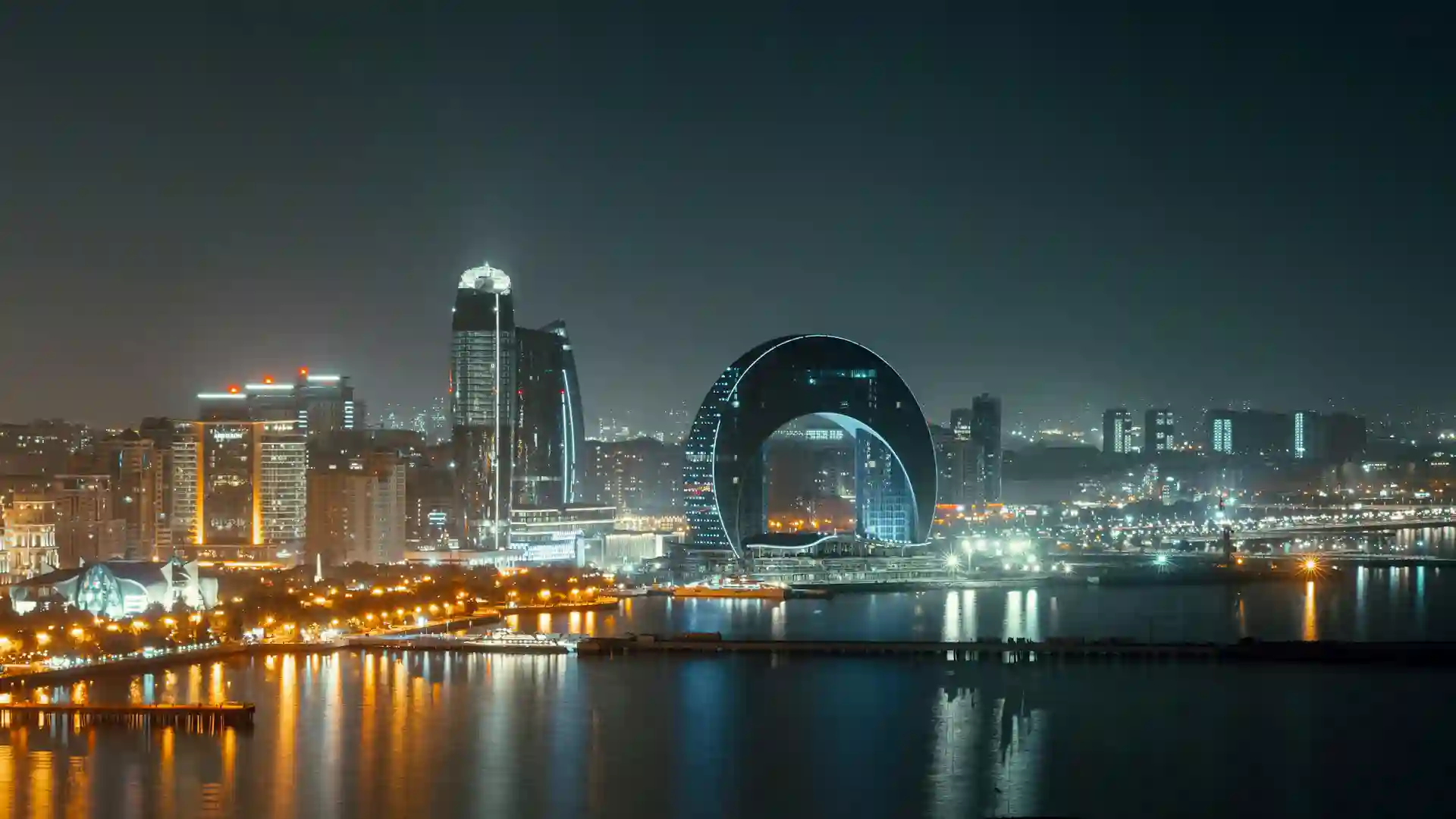
The capital and largest city is Baku, a Caspian Sea port famous for its walled Old City, seafront boulevard and flame-shaped glass towers. Azerbaijani (Azeri), a Turkic language written in a Latin alphabet, is the official language. The Azerbaijani manat (AZN) is the national currency.
Azerbaijan is classified by the World Bank as an upper-middle-income economy and sits in the “high human development” group on the UN Human Development Index (HDI). Oil and gas still dominate exports, but agriculture, logistics, services and tourism are gaining weight as the country works to diversify beyond hydrocarbons.
| Metric | Value |
|---|---|
| Official name | Republic of Azerbaijan |
| Capital | Baku |
| Largest city | Baku |
| Population (approx., as of mid-2020s) | ≈10.3 million people |
| Total area | 33,400 sq mi (86,600 km²) |
| Population density (approx.) | ≈300 people/sq mi (≈120–130 people/km²) |
| Official language | Azerbaijani (Azeri) |
| Currency | Azerbaijani manat (AZN) |
| Government type | Unitary semi-presidential republic with a strong presidency |
| Main religion | Islam (majority Shia; officially secular state) |
| Main time zone | Azerbaijan Time (AZT), UTC+4 |
| Neighbouring countries | Russia, Georgia, Armenia, Iran, Turkey (via Nakhchivan exclave); Caspian Sea coast to the east |
| Calling code | +994 |
| Internet top-level domain | .az |
| ISO country codes | AZ (alpha-2), AZE (alpha-3) |
Where Is Azerbaijan Located?
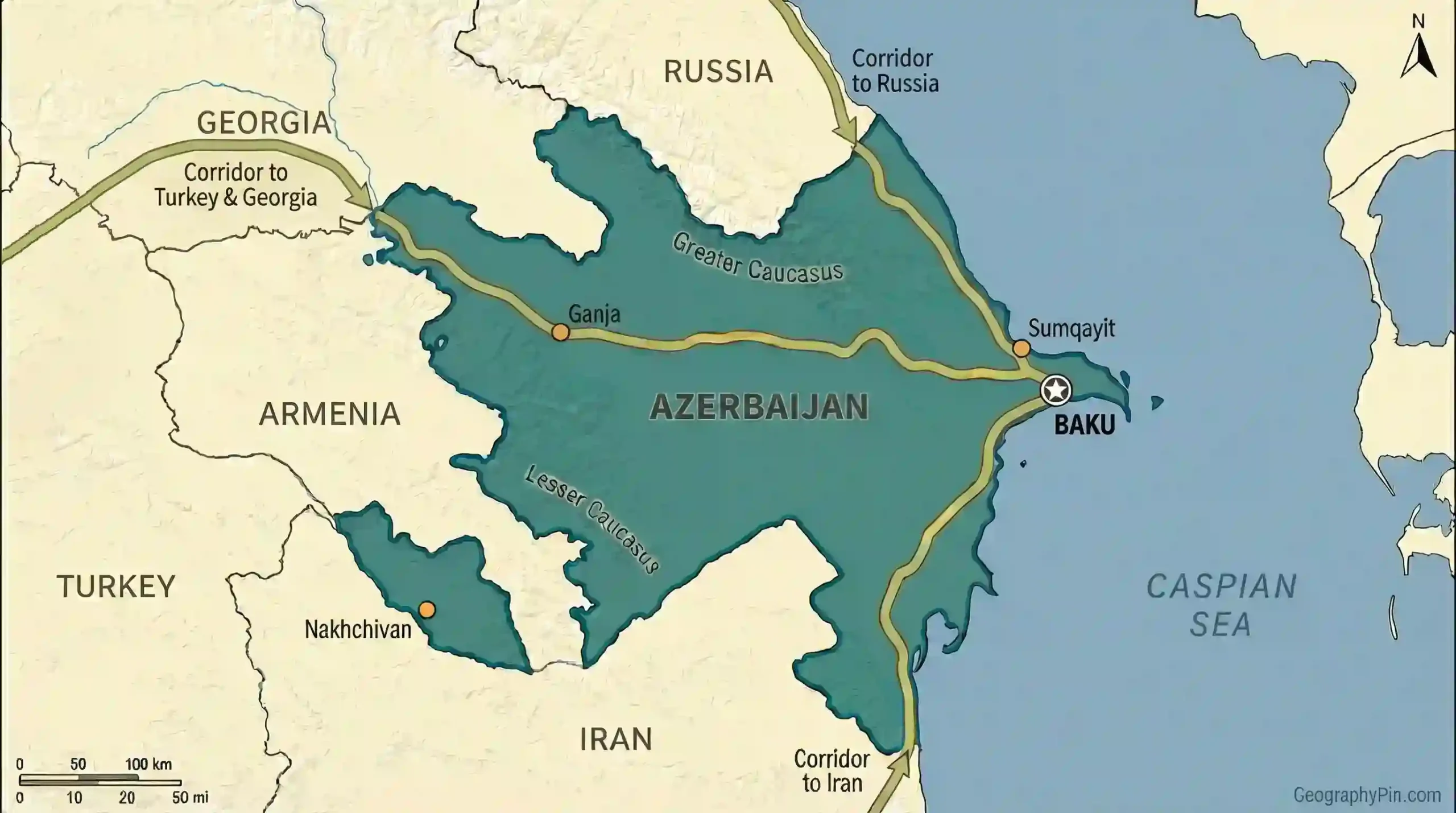
Azerbaijan lies in the South Caucasus, a compact but strategic region between the Black Sea and the Caspian Sea. On any Azerbaijan map and geography overview, you’ll see the country tucked between Russia to the north, Georgia to the northwest, Armenia to the west and southwest, and Iran to the south. To the east, Azerbaijan has a long shoreline on the Caspian Sea, the world’s largest inland body of water.
The main part of Azerbaijan forms a wedge of land between the Greater Caucasus Mountains in the north and the Lesser Caucasus to the west. A separate landlocked exclave, the Nakhchivan Autonomous Republic, lies to the southwest between Armenia, Iran and Turkey, giving Azerbaijan a short but important border with Turkey. The country stretches roughly 250 miles (about 400 kilometres) from north to south and around 310 miles (about 500 kilometres) from west to east.
Baku stands on the Absheron Peninsula, which juts into the Caspian Sea and shelters a natural harbour. Other major cities such as Ganja and Sumqayit sit inland along the Kura River plain or near the coast. This position makes Azerbaijan a key link between Russia and Iran and between Central Asia and the Black Sea world, which explains why it has become a central node for east–west and north–south transport and energy corridors.
Is Azerbaijan in Europe or Asia?
Geographically, the South Caucasus is often treated as a bridge between Europe and Asia. Politically and in most statistics, Azerbaijan is usually grouped with Western Asia or the wider South Caucasus rather than with the European Union. At the same time, it belongs to several pan-European bodies, such as the Council of Europe and the OSCE, so you will often see it described as a country “at the crossroads of Eastern Europe and Western Asia” rather than purely one or the other.
Landscapes, Climate & Nature
Azerbaijan’s landscapes pack a lot into a relatively small area. About half the country is mountainous, dominated by the Greater Caucasus range in the north, the Lesser Caucasus to the west and southwest, and the Talysh Mountains in the far southeast. The highest point is Mount Bazardüzü at 14,652 feet (4,466 metres), while the lowest point is the Caspian Sea surface at around 92 feet (28 metres) below global sea level. Between these uplands lies the Kura–Aras lowland, a broad plain with fertile soils but also patches of salted and degraded land.
The Caspian coastline stretches for roughly 440 miles (about 700 kilometres) along Azerbaijan’s eastern edge and includes sandy beaches, shallow bays and offshore oil fields. The country is also famous for its mud volcanoes: several hundred conical hills that ooze cold mud and gas, especially around Baku and Gobustan. These features, together with natural gas seeps that burn continuously in places like Yanar Dağ, have helped give Azerbaijan its popular nickname, the “Land of Fire”.
Despite its size, Azerbaijan is often described as having eight or nine of the world’s main climate types, depending on how climatologists group them. Coastal and lowland areas tend to have hot, dry summers and mild winters, while the Lankaran region near the Talysh Mountains has a humid subtropical climate with annual rainfall above 60 inches (over 1,500 millimetres). In contrast, high-mountain zones see heavy snowfall and winter temperatures well below freezing, which is why ski resorts such as Shahdag and Tufandag can operate for long seasons.
Environmental pressures reflect this mix of natural wealth and heavy industry. Decades of oil extraction left polluted soils and water around parts of the Absheron Peninsula. Some mountain valleys have experienced deforestation and erosion, while changing rainfall and snowmelt patterns raise concerns about long-term water availability. Shifts in Caspian Sea level also pose risks for coastal settlements, ports and energy infrastructure. The government has expanded national parks, launched reforestation programmes and put more emphasis on cleaning up old industrial sites, but many challenges remain.
Major Rivers, Mountains & Natural Regions
The Kura (Kur) River is Azerbaijan’s longest river, flowing roughly 940 miles (about 1,515 kilometres) from Turkey and Georgia across the Kura–Aras lowland to the Caspian Sea. The Aras River runs along much of the southern border with Iran before joining the Kura. Together they water a wide plain that is central to the country’s agriculture. Other important rivers include the Alazani (Ganikh) in the northwest and smaller streams in the Talysh foothills.
The Greater Caucasus in the north forms a natural barrier with Russia and includes several peaks over 12,000 feet (3,650 metres). The Lesser Caucasus in the west and the Talysh Mountains in the southeast create more rugged terrain and forested valleys. Geographers often divide Azerbaijan into distinct natural regions: the Greater Caucasus, Lesser Caucasus, Kura–Aras lowland, Lankaran lowland, and the Absheron Peninsula. Protected areas such as Shahdag National Park and the Gobustan State Historical and Cultural Reserve safeguard mountain ecosystems, semi-desert landscapes, rock art and mud volcano fields.

People, Languages & Culture
Azerbaijan’s population is relatively young and increasingly urban. Just over half – close to 60 percent – of residents live in cities and towns, with Baku by far the largest urban centre. Ethnically, the country is dominated by Azerbaijanis (Azeris), who make up the vast majority of the population. Smaller minorities include Lezgins, Talysh, Russians and others, often concentrated in particular regions or in major cities.
Azerbaijani (Azeri) is the official language and belongs to the Turkic language family. It uses a Latin-based alphabet introduced in the 1990s. Russian remains widely understood, especially among older generations and in business, while English is increasingly common in Baku and among younger people. For most visitors, Azerbaijani is the most useful language to know, but a mix of Azerbaijani, Russian and English often works in tourism settings.
Azerbaijan is frequently described as one of the most secular Muslim-majority states. Around 95 percent of people identify as Muslim, with a Shia majority and a large Sunni minority, but individual levels of religious practice vary. Everyday public life, especially in Baku, is shaped as much by Soviet-era habits and global pop culture as by religious traditions. Cultural life blends Turkic, Persian, Russian and Caucasian influences: mugham vocal music, colourful carpets, tea houses, generous hospitality and dishes such as plov (rice pilaf) and various kebabs all play a role. Novruz, the spring New Year, is one of the most important holidays, celebrated with bonfires, special sweets and family gatherings.
- Population: roughly 10.2–10.3 million (mid-2020s)
- Urban share: around 58 percent of people live in cities and towns
- Median age: about 33–34 years, meaning a relatively young population
- Life expectancy: in the low to mid-70s in years, depending on gender and dataset
National Symbols
Azerbaijan’s flag has three horizontal stripes – blue, red and green – with a white crescent and an eight-pointed star in the centre. The blue stands for Turkic heritage, the red for modern nation-building and progress, and the green for the country’s Islamic cultural roots. The national emblem features the same colours arranged around a flame, linking back to the “Land of Fire” idea. Together, the flag and emblem appear on government buildings, banknotes and official documents, and they are widely used at sports events and public celebrations.
Government, Politics & International Role
Azerbaijan is formally a unitary semi-presidential republic. The president is head of state and holds extensive powers over the executive, while a prime minister and cabinet handle day-to-day government. Legislative power rests in a single-chamber parliament, the Milli Majlis. Since the early 1990s, politics has been dominated by the New Azerbaijan Party and the Aliyev family: Heydar Aliyev led the country from 1993 to 2003, followed by his son Ilham Aliyev.
International watchdogs often describe Azerbaijan’s system as highly centralised and criticise restrictions on opposition activity and independent media. The leadership, in turn, emphasises state stability, economic growth and the need to protect national security, especially in light of the long conflict over Nagorno-Karabakh. Constitutional changes have extended presidential terms and adjusted the balance between branches of government, strengthening the presidency further.
Azerbaijan is an active member of numerous regional and global organisations. It belongs to the United Nations, the Council of Europe, the Organization for Security and Co-operation in Europe (OSCE), the Non-Aligned Movement, the Organisation of Islamic Cooperation and the Organization of Turkic States, among others. The country cooperates with NATO through the Partnership for Peace programme and has taken part in peacekeeping missions abroad. Its energy pipelines and transport routes make it a key partner for the European Union as the EU seeks to diversify gas imports.
Security policy has been shaped by the conflict over Nagorno-Karabakh. After the first war in the early 1990s, Armenian forces controlled the region and surrounding districts. In 2020, Azerbaijan recaptured large areas in a six-week war, and in 2023 a short offensive brought the remaining territory under Baku’s control, prompting almost all Armenian residents of the enclave to leave. Today the government focuses on consolidating this control, negotiating a peace treaty with Armenia and rebuilding former front-line areas. In 2024, Azerbaijan hosted the COP29 UN climate summit in Baku, underlining its role in international climate diplomacy while also highlighting the challenge of reducing emissions in a hydrocarbon-dependent economy.
Economy & Key Industries
Thanks to its oil and gas resources, Azerbaijan’s economy is one of the more prosperous in the post-Soviet space, classified as upper-middle income. However, it is also highly dependent on hydrocarbons. GDP per person in current US dollars is in the low-$7,000s in the mid-2020s, while purchasing-power-adjusted income is in the low-20,000s in international dollars. Behind these averages, there are significant differences between the capital region and more rural areas, and between oil-related sectors and the rest of the economy.
Oil, Gas and the State Oil Fund (SOFAZ)
Oil has been central to Baku’s story since the late 19th century, and today offshore fields in the Caspian Sea remain the backbone of Azerbaijan’s export earnings. Projects such as the Azeri–Chirag–Gunashli oil field and the Shah Deniz gas field supply pipelines that cross Georgia and Turkey to reach global markets. Hydrocarbons account for around 90 percent of exports and roughly half or more of state revenue in many years, which makes the budget and currency sensitive to global price swings.
The State Oil Fund of Azerbaijan (SOFAZ) manages part of the country’s oil and gas income. Its goals are to save for future generations, support key infrastructure projects and stabilise the economy during downturns. Transfers from SOFAZ finance major roads, railways, social housing, and reconstruction in war-affected regions, as well as bolstering currency reserves during periods of low oil prices.
- Baku–Tbilisi–Ceyhan (BTC) pipeline: carries crude oil to the Mediterranean coast of Turkey.
- South Caucasus Pipeline (SCP) and TANAP/TAP: move natural gas from Shah Deniz through Georgia and Turkey towards southern and central Europe.
- Baku–Supsa and other regional lines: provide additional export routes for Caspian oil.
Non-Oil Economy and Diversification
Reducing dependence on hydrocarbons is one of Azerbaijan’s main long-term goals. Agriculture still plays a major role in rural livelihoods, with key products including wheat, cotton, grapes, pomegranates, nuts and vegetables. The humid Lankaran region supports tea and citrus production. Food processing, petrochemicals, textiles and construction materials contribute to industry, while small and medium-sized enterprises provide jobs in trade and services.
In Baku and other urban centres, the non-oil services sector has grown quickly. Retail, hospitality, banking, telecommunications and IT-related businesses benefit from rising incomes and improved infrastructure. The government promotes industrial parks and special economic zones to attract foreign investors and encourage higher-value manufacturing, although progress is gradual and uneven.
Transport Corridors and Logistics Hub Role
Azerbaijan’s position between Russia, Iran, Central Asia and the Black Sea gives it strong potential as a transport and logistics hub. Major investments include the new Port of Baku at Alat, designed to handle growing container traffic across the Caspian, and the Baku–Tbilisi–Kars railway, which links the Caspian region directly to Turkey and, via Istanbul, to European rail networks.
Two big corridor ideas shape current policy:
- The Middle Corridor: a route from China through Central Asia, across the Caspian Sea to Azerbaijan, then on to Georgia, Turkey and Europe.
- The North–South corridor: linking Russia to Iran and the Indian Ocean via Azerbaijan’s road and rail network.
By improving customs procedures, building logistics centres and expanding its port and rail capacity, Azerbaijan hopes to capture more transit trade and develop services around warehousing, freight handling and value-added processing. At the same time, the country is starting to invest in solar and wind power, especially along its windy coasts, and has tied these ambitions to climate finance initiatives launched around the COP29 summit. Its emissions-reduction pledge – a 40 percent cut by 2050 compared with 1990 levels, depending partly on international support – is one sign of this shift.
Cities, Regions & Travel Highlights
Baku
Baku dominates Azerbaijan’s urban network. The city curves around a wide bay on the Caspian Sea and combines several layers of history and architecture. The UNESCO-listed Icherisheher (Old City) includes narrow lanes, traditional houses, the Maiden Tower and the Shirvanshah’s Palace. Around it, 19th-century oil-boom boulevards show European-style facades, while modern landmarks such as the Flame Towers and the flowing Heydar Aliyev Center add a very different skyline. A long seaside promenade, the Baku Boulevard, makes the city’s geography easy to understand: Caspian water on one side and rising hills on the other.
Historic Towns & Cultural Landscapes
West of Baku, the Gobustan State Historical and Cultural Reserve preserves thousands of ancient rock carvings that show hunting scenes, boats and ritual dances. Nearby mud volcanoes bubble and occasionally erupt, offering one of the most unusual landscapes in the region. Further inland, Ganja – Azerbaijan’s second-largest city – serves as an industrial and cultural centre close to the Lesser Caucasus, while Mingachevir, built around a large reservoir on the Kura River, hosts important hydro-power facilities.
Sheki, in the northern foothills, is known for its former khan’s palace decorated with colourful stained glass, narrow streets and traditional sweets. It gives a good sense of a historic Caucasus market town. In the south, Lankaran and the surrounding Talysh foothills are green and humid, with forests, tea plantations and citrus orchards that feel very different from the dry central lowlands.
Karabakh and Post-Conflict Tourism
The Karabakh region, including the city of Shusha, has become a focus of reconstruction after the recent conflicts. Before the wars, it was known for its forests, meadows and cultural heritage. Today, large-scale de-mining and rebuilding projects aim to make roads, towns and tourist sites safe again. The government promotes Karabakh as a future centre for mountain tourism, cultural festivals and nature trips, but access and facilities are still developing, so travellers need to pay close attention to current conditions and official guidance.
Mountain Resorts and the Caspian Coast
In winter, ski resorts such as Shahdag and Tufandag attract visitors to the Greater Caucasus with pistes, chairlifts and views of high peaks. In summer, many city residents and domestic tourists head for cooler mountain villages and forested valleys in the north and west, where temperatures are several degrees lower than in Baku and the plains.
The Caspian coast offers another set of travel options: resort towns, beaches and spa complexes line sections of the shoreline, especially along the Absheron Peninsula and further north. Water quality and facilities vary, but in the last decade new private resorts and public beach improvements have tried to make the coast more attractive, both to locals and to visitors from neighbouring countries.
History in Brief
The land that is now Azerbaijan has been inhabited for many thousands of years. Prehistoric rock carvings in Gobustan show hunting scenes, boats and rituals dating back up to 20,000 years. In antiquity, much of the area formed the kingdom of Caucasian Albania, influenced by Persian empires and later by Rome and Byzantium. From the 7th century, Arab armies brought Islam, and over the following centuries Turkic groups settled in the region, shaping the language and identity of modern Azerbaijanis.
In the early modern period, much of today’s Azerbaijan lay under Persian rule, divided into semi-independent khanates. During the 19th century, the Russian Empire expanded south into the Caucasus and took control of northern Azerbaijan through treaties with Iran. Oil discoveries turned Baku into a major industrial city by the late 1800s. After the collapse of the Russian Empire in 1917, the Azerbaijan Democratic Republic was proclaimed in 1918 and is often described as the first parliamentary republic in the Muslim world.
The independent republic lasted only until 1920, when Bolshevik forces incorporated Azerbaijan into the Soviet Union as the Azerbaijan Soviet Socialist Republic. Under Soviet rule, the country industrialised further and became a key oil supplier, especially during the Second World War. In the late 1980s, political liberalisation and mounting tensions over Nagorno-Karabakh set the stage for both independence and conflict.
Azerbaijan declared independence in 1991 after the Soviet Union collapsed. The first Nagorno-Karabakh war with Armenia left Armenian forces in control of the region and several surrounding districts, and hundreds of thousands of Azerbaijanis displaced. In 1993, Heydar Aliyev came to power, stabilising the state and negotiating major energy projects such as the Baku–Tbilisi–Ceyhan pipeline. Since 2003, his son Ilham Aliyev has led the country, overseeing an oil-fuelled economic boom and major infrastructure projects.
In 2020, Azerbaijan recaptured large parts of the territories lost in the first war during a six-week conflict, and in 2023 it took full control of the remaining enclave, leading to a mass departure of ethnic Armenians from Nagorno-Karabakh. Today, rebuilding former conflict zones and redefining relations with neighbours are among the central tasks facing the state.
| Period / Year | Key Event |
|---|---|
| Prehistory – c. 20,000–5,000 BCE | Rock carvings created at Gobustan show that humans lived and hunted in the area thousands of years ago. |
| c. 4th century BCE – 7th century CE | Caucasian Albania and neighbouring states control much of present-day Azerbaijan, influenced by Persian and Roman/Byzantine powers. |
| 7th–11th centuries | Arab rule brings Islam; later Turkic dynasties and the Seljuks shape the region’s language and culture. |
| 1828 | Treaty of Turkmenchay confirms Russian control over northern Azerbaijan, while southern areas remain in Iran. |
| 1918–1920 | Azerbaijan Democratic Republic exists as an independent state before being absorbed into the Soviet Union. |
| 1920–1991 | Azerbaijan Soviet Socialist Republic; Baku becomes a major oil centre of the USSR. |
| 1991 | Azerbaijan regains independence as the Soviet Union collapses; conflict over Nagorno-Karabakh escalates. |
| 1993–2003 | Heydar Aliyev leads Azerbaijan, stabilising the state and negotiating major energy projects. |
| 2006 | Baku–Tbilisi–Ceyhan pipeline opens, boosting oil exports and state revenues. |
| 2020 & 2023 | Azerbaijan regains control over most, then all, of Nagorno-Karabakh and surrounding districts, reshaping regional geopolitics. |
Challenges & Future Trends
Azerbaijan faces a mix of economic, social, environmental and geopolitical challenges, alongside important opportunities. How it balances diversification, reforms, environmental protection and post-conflict reconstruction will shape its trajectory over the coming decades.
Economic Diversification
One of the biggest long-term challenges is dependence on oil and gas. Hydrocarbons still provide most export earnings and a large share of state income. This brings vulnerability to price shocks and to faster-than-expected global moves away from fossil fuels. Diversifying into agriculture, manufacturing, logistics, IT and tourism is a strategic priority, but building a broad, competitive non-oil sector takes time, investment and predictable rules for businesses.
Social and Demographic Trends
Population growth is modest but positive, with just over 10 million people today compared with fewer than 8 million in the early 1990s. Urban areas, especially Baku and the Absheron Peninsula, have attracted most investment, creating gaps with rural regions. Azerbaijan’s HDI score places it in the “high human development” group, but still below most EU countries. Continued progress in education quality, job creation for young people, health services and space for civil society will be important if the country wants to keep talent at home and avoid widening inequalities.
Environment and Climate Risk
Environmental concerns are increasingly visible. Old oil fields, industrial sites and Soviet-era infrastructure left a legacy of polluted land and air around parts of Baku and other industrial centres. Climate change may alter rainfall patterns, aggravate water scarcity in some regions and affect the Caspian Sea’s level, threatening coastal infrastructure and ecosystems. On the positive side, Azerbaijan has increased protected-area coverage, launched reforestation and land-rehabilitation schemes and set emissions-reduction targets, including a pledge to cut greenhouse-gas emissions by about 40 percent by 2050 compared with 1990 levels, depending partly on international support.
Post-Conflict Reconstruction and Regional Peace
The post-conflict situation in and around Karabakh will shape the coming decades. The government aims to clear landmines, rebuild towns and infrastructure, and encourage the return of internally displaced Azerbaijanis to areas that were under Armenian control for nearly thirty years. Relations with Armenia remain fragile, but ongoing talks raise the possibility of a long-term peace treaty and new regional transport links. How these processes unfold will affect not only Azerbaijan’s internal development but also the wider security and connectivity of the South Caucasus.
FAQ
Is Azerbaijan safe to visit?
Most trips to Azerbaijan, especially to Baku, Sheki, Ganja and other main tourist areas, pass without serious problems. As in any large city, petty crime such as pickpocketing can occur, so normal precautions are important. Some former front-line zones near the borders with Armenia remain mined or restricted and are not suitable for casual travel. Travellers should always check the latest advice issued by their own government before visiting.
Is Azerbaijan in Europe or Asia?
Azerbaijan is usually described as a country at the crossroads of Eastern Europe and Western Asia. Geographers often place it in Western Asia or simply in the “South Caucasus” region. It is not part of the European Union, but it does belong to some pan-European organisations such as the Council of Europe and the OSCE.
Do I need a visa to visit Azerbaijan?
Many visitors need a visa to enter Azerbaijan, and a large number of nationalities can apply online for an electronic visa through the official government portal. Requirements and border rules can change, so the safest approach is to check both the official Azerbaijani e-visa website and your own country’s travel advice before you book tickets.
What language is most useful for visitors to Azerbaijan?
The main language is Azerbaijani (Azeri). Learning a few basic phrases is very helpful and appreciated. Russian is widely understood, especially among older people, and English is increasingly common in central Baku and in tourist services. For most visitors, a mix of simple Azerbaijani phrases plus English or Russian works well.
Is Azerbaijan expensive compared with other countries in its region?
Prices in Azerbaijan are mixed. Baku can feel similar to mid-range Eastern European cities for eating out and accommodation, especially in central districts, while smaller towns and rural areas are usually cheaper. Compared with many Western European countries, everyday costs such as public transport and local food are generally lower, but imported goods and high-end hotels can be pricey. Actual costs depend a lot on your travel style.
What is Azerbaijan best known for?
Azerbaijan is widely known for its oil and gas industry, its mud volcanoes and natural gas fires that inspired the “Land of Fire” nickname, its carpets and mugham music, and the mix of medieval and ultra-modern architecture in Baku. It is also recognised for its mountain scenery in the Greater and Lesser Caucasus and for its role as a transport and energy hub in the wider region.
What is the climate like in Azerbaijan?
The climate varies a lot across the country. Central lowlands and the Absheron Peninsula have hot, dry summers and fairly mild winters with little snow. The Lankaran region in the southeast is warm and humid with plenty of rain, making it good for tea and citrus. Mountain areas are much cooler: winters are snowy and long, while summers are short and fresh, which is why many city residents escape to highland villages when the lowlands become very hot.
What Did We Learn Today?
- Azerbaijan lies in the South Caucasus at the crossroads of Eastern Europe and Western Asia, with a long coastline on the Caspian Sea.
- It has just over 10 million people, a young population and a mix of Azerbaijani, Russian and other languages and cultures.
- The country is a highly centralised semi-presidential republic whose economy is dominated by oil and gas but classed as upper-middle income with a high HDI score.
- Landscapes range from high Caucasus peaks and forested valleys to semi-desert lowlands, tea-growing subtropical zones and a long Caspian shoreline dotted with mud volcanoes.
- Future choices about diversification, environmental protection and post-conflict reconstruction in Karabakh will strongly influence Azerbaijan’s development path and its role in the wider region.
Key data sources for this Azerbaijan country profile include the World Bank, UNDP Human Development Reports, the State Statistical Committee of the Republic of Azerbaijan and official government releases as of the mid-2020s.