What is Albania?
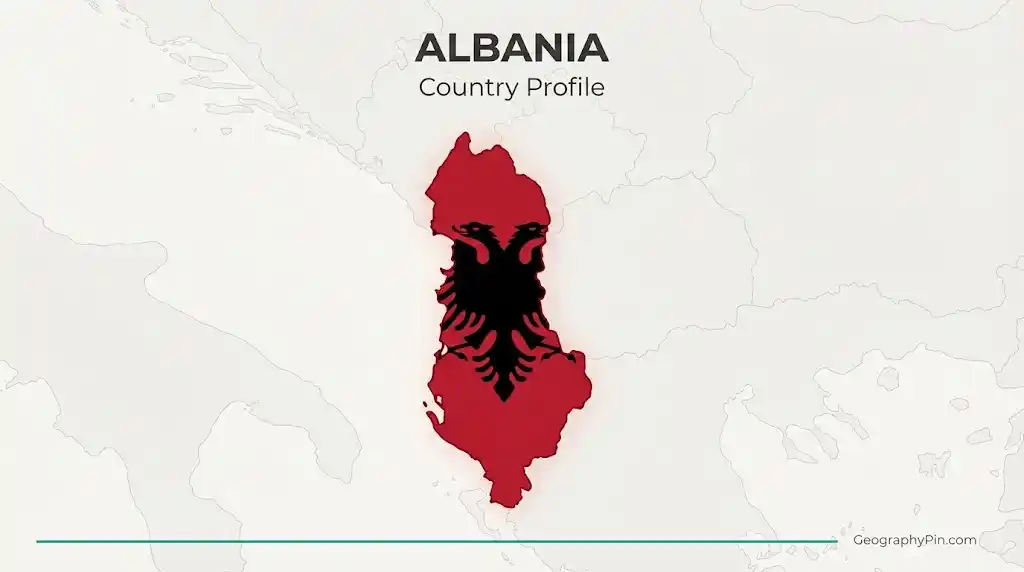
Albania is a country in southeastern Europe on the western Balkan Peninsula, facing the Adriatic and Ionian Seas. Its capital is Tirana, and about 2.4 million people live in Albania based on the 2023 census. The country is known for its high mountains, Mediterranean beaches and ongoing progress toward membership of the European Union.
Quick Facts & Key Numbers
Albania is one of Europe’s smaller states by area but has a fairly dense population for its size. It covers about 11,100 square miles (28,748 square kilometres), roughly comparable to the US state of Maryland or the country of Armenia. The 2023 census recorded 2,402,113 residents in Albania, giving a population density of about 84 people per square kilometre (around 220 people per square mile).
Most Albanians now live in towns and cities, with around two-thirds of the population classed as urban. Tirana is the dominant metropolis, while cities such as Durrës, Vlorë, Shkodër, Berat, Gjirokastër and Korçë act as regional hubs. Albanian is the official language, the national currency is the lek (ALL), and Albania follows Central European Time (UTC+1, UTC+2 in summer).
Key figures in this Albania country profile are based mainly on the 2023 census, World Bank and UNDP data, and NATO and EU publications up to 2024–2025, with values rounded so they are easy to remember.
| Metric | Value |
|---|---|
| Capital city | Tirana |
| Largest city | Tirana (political, economic and cultural centre) |
| Population (2023 census) | ≈2,402,000 residents (2,402,113) |
| Total area | ≈11,100 sq mi (28,748 km²) |
| Population density | ≈80–85 people per km² (about 210–220 per sq mi) |
| Official language | Albanian |
| Currency | Albanian lek (ALL) |
| Government type | Unitary parliamentary constitutional republic |
| Main time zone(s) | Central European Time (UTC+1), Central European Summer Time (UTC+2) |
| Neighbouring countries | Montenegro (NW), Kosovo (NE), North Macedonia (E), Greece (S & SE); across the Adriatic from Italy |
| Coastline length | ≈225–300 mi (≈360–480 km), depending on how bays and lagoons are counted |
| Life expectancy | ≈79–80 years (2023–2024) |
| ISO code / calling code / TLD | AL / +355 / .al |
Where Is Albania Located?
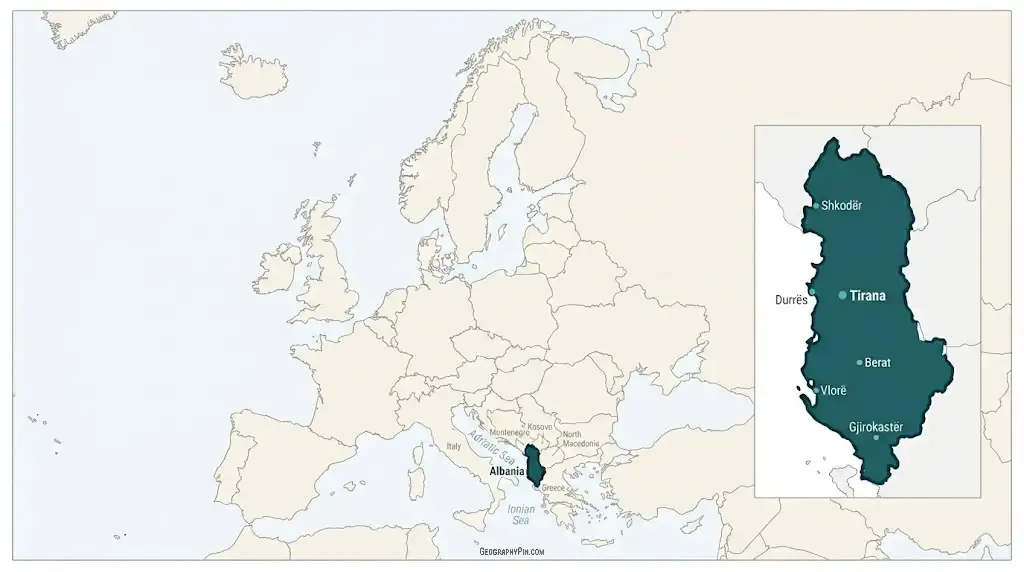
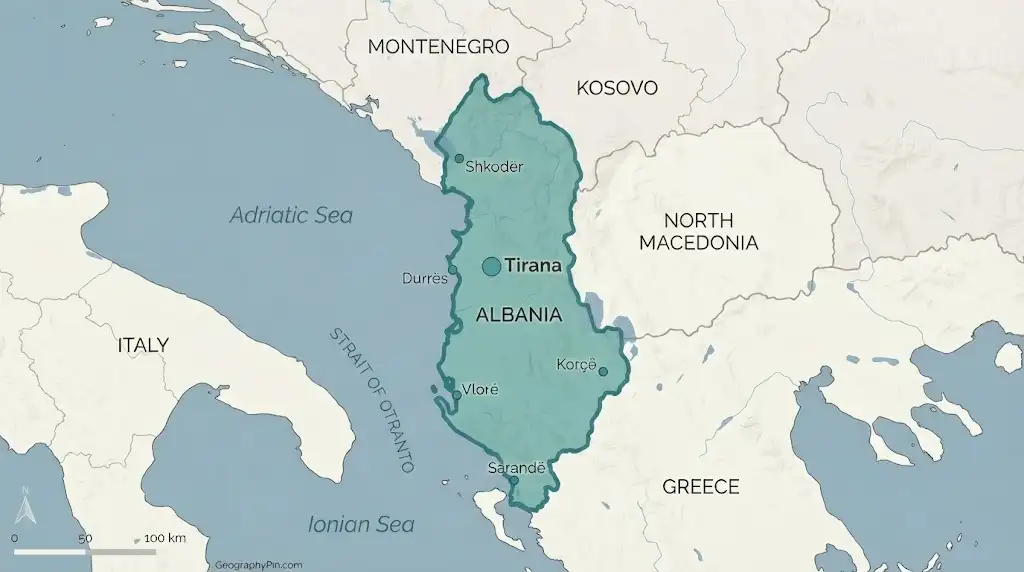
Albania lies in southeastern Europe, on the western side of the Balkan Peninsula. On a simple mental map, picture Italy’s “boot” on the left and Greece in the south; Albania sits across the Adriatic Sea from southern Italy and directly north of Greece. It forms part of the Western Balkans, together with countries such as Montenegro, Kosovo, North Macedonia and Serbia.
To the northwest, Albania borders Montenegro. Kosovo lies to the northeast, North Macedonia to the east, and Greece to the south and southeast. The entire western edge is coastal: the Adriatic Sea runs along most of the shoreline, while the Ionian Sea forms the more rugged southern segment often referred to as the Albanian Riviera. The Strait of Otranto, at the entrance to the Adriatic, is only about 45 miles (roughly 72 kilometres) wide at its narrowest, bringing Albania close to Italy.
Inside the country, Tirana is located slightly inland in the central western lowlands, roughly halfway between the north and south. Durrës, the main port, lies about 20 miles (around 30 kilometres) west of Tirana on the Adriatic. Shkodër in the north stands near Lake Shkodra, shared with Montenegro, while Korçë in the southeast is set on a high plateau close to the Greek and North Macedonian borders. Together, these locations underline Albania’s role as a crossroads between Central Europe, the Mediterranean and the rest of the Balkans.
Albania’s Landscapes, Climate & Nature
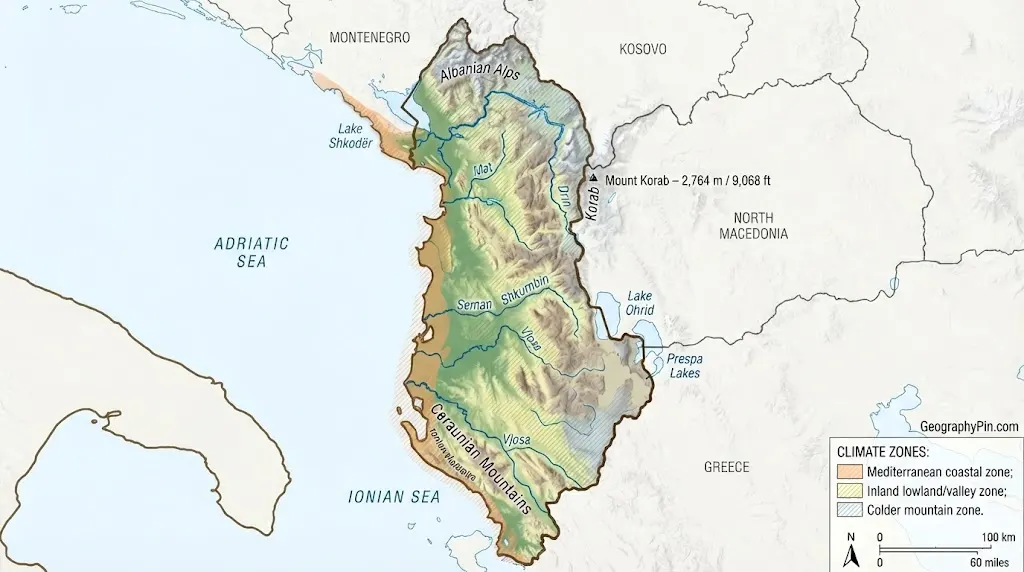
Albania is often described as one of Europe’s most mountainous countries. Around two-thirds of its territory consists of hills and mountains, including the Albanian Alps in the north and several ranges in the east and south. The highest point is Mount Korab at about 9,068 feet (2,764 metres), on the border with North Macedonia. By contrast, the western coastal plain is low and fertile, with river deltas and lagoons where agriculture and wetlands sit side by side.
The coastline changes character from north to south. Along the Adriatic, the shore is mostly low and sandy, with wide beaches and shallow waters. Further south, where Albania faces the Ionian Sea, mountains rise much closer to the water. The Ceraunian Mountains form a steep backdrop to narrow bays and coves between Vlorë and Sarandë, creating dramatic sea–cliff scenery. Large lakes—Lake Shkodra in the north, Lake Ohrid and the Prespa Lakes in the southeast—are shared with neighbouring countries and provide important habitats for fish and migratory birds.
The climate is mainly Mediterranean along the coast, with mild, wet winters and hot, dry summers. Inland valleys have more continental conditions, with hotter summers and colder winters, while the mountains see heavy snowfall. In Tirana, average January temperatures are around 41°F (5°C) and July averages fall in the mid to upper 70s°F (about 25–27°C). Mountain areas can drop well below freezing in winter, especially above roughly 3,300 feet (1,000 metres). This range of climates supports olive groves and citrus trees near the sea, and beech and conifer forests on higher slopes.
Environmentally, Albania still contains some of Europe’s more intact river and mountain ecosystems. The Vjosa River, running about 168 miles (270 kilometres) from Greece through southern Albania to the Adriatic, is often described as one of the last large wild rivers in Europe. In 2023 Albania created the Vjosa Wild River National Park to protect this system as a continuous “wild river” corridor, and in 2025 the wider Vjosa Valley was recognised as a UNESCO Biosphere Reserve, underlining both its ecological importance and the need to manage pollution, dams and construction carefully.
Major Rivers, Mountains & Natural Regions
Several major rivers shape Albania’s landscape. The Drin is the longest river system at roughly 208 miles (335 kilometres), draining much of northern Albania before reaching the Adriatic. The Vjosa flows through the south, while the Shkumbin, Seman and Mat cross the central interior and coastal plains. These rivers form fertile valleys where many towns and farms are located.
Mountain regions can be grouped into a few broad zones: the Albanian Alps in the north, with deep valleys and peaks often above 6,500 feet (2,000 metres); the Korab and Sharr ranges in the east; and the Ceraunian Mountains overlooking the Ionian Sea in the southwest. Protected areas such as Valbonë Valley and Theth in the north, and Shebenik–Jabllanicë in the east, conserve highland forests, alpine meadows and glacial valleys. On the coast, Divjakë–Karavasta National Park protects a large lagoon and wetlands important for species such as the Dalmatian pelican.
People, Languages & Albanian Culture
Population & Urbanisation
The 2023 census recorded about 2.4 million residents in Albania, a notable decline from just over 2.8 million in 2011. This drop reflects both lower birth rates and long-term emigration. Younger and highly educated Albanians are especially likely to move abroad for study or work, which can leave gaps in the domestic labour market.
At the same time, the share of people living in towns and cities has risen. Around 65% of Albanians are now classed as urban, with the Tirana–Durrës axis forming a densely populated corridor. Outside this corridor, smaller cities and towns anchor regional life in the north, southeast and south, while many rural communities still rely heavily on agriculture and remittances from relatives working overseas.
Ethnic Groups & Languages
Albania is relatively homogeneous in ethnic terms. Census and survey data indicate that ethnic Albanians make up the vast majority of residents, with recognised minorities including Greeks, Macedonians, Aromanians (Vlachs), Roma and others. Albanian is the official language and forms its own branch of the Indo-European family. Two main dialect groupings are often named: Gheg in the north and Tosk in the south, with the standard language based mainly on Tosk.
Many Albanians are multilingual. Due to migration, media and tourism, Italian, Greek and English are fairly widespread as second or third languages, especially in cities and coastal areas and among younger people. This makes it easier for visitors to communicate in major tourist spots, even if they do not speak Albanian.
Religion & Society
Albania has a mix of religious communities but is a secular state with no official religion. Historically, Sunni Islam became widespread under Ottoman rule, alongside Bektashi Sufi communities, while Roman Catholic and Orthodox Christian communities remained strong in particular regions. Modern data show a combination of Muslims, Christians, people who describe themselves as “believers without denomination” and others who identify as non-religious.
In daily life, religious identity often sits alongside a strong sense of being “just Albanian”. Mixed friendships and families across religious lines are common, and public holidays include both national and religious celebrations. Social ties tend to be shaped as much by family, region and shared experiences as by formal religious categories.
Culture, Music & Food
Albanian culture blends highland traditions, Ottoman-era influences and modern European trends. Traditional iso-polyphonic singing from southern Albania is recognised by UNESCO as part of the Intangible Cultural Heritage of Humanity. Folk dances and regional costumes are still used at weddings, local festivals and national events, especially on Independence Day and Flag Day in late November.
Everyday food follows a broadly Mediterranean pattern. People eat plenty of bread, cheese, yoghurt, seasonal vegetables, grilled meat and, along the coast, fresh fish and seafood. Dishes like byrek (savoury pastry), tavë kosi (baked meat with yoghurt) and various stews are common. Coffee culture is strong; cafés are central meeting places in towns and cities, and you are rarely far from a small bar or coffee shop in urban areas.
Government, Politics & International Role
Albania is a unitary parliamentary constitutional republic. The president serves as head of state with mostly ceremonial duties, while the prime minister and cabinet lead the executive branch. The unicameral Assembly of Albania is elected by proportional representation and passes laws, approves the government and oversees the budget. Courts, including a Constitutional Court and a High Court, form the judicial branch and are undergoing long-term reforms.
Tirana hosts the main state institutions: parliament, the president’s office, the prime minister’s office and most ministries. Administratively, Albania is divided into 12 counties, which are further subdivided into municipalities responsible for local services and planning. Since the early 1990s, the country has moved from one-party communist rule to a multi-party democratic system, although issues such as political polarisation, corruption and judicial independence remain central topics in public debate.
Internationally, Albania is firmly anchored in Euro-Atlantic structures. It joined NATO in 2009, becoming part of the North Atlantic Alliance and hosting NATO-related infrastructure, including an air base project at Kuçovë. In Europe, Albania has been an official candidate for European Union membership since 2014, and formal accession negotiations opened in 2022. By 2025, all negotiation clusters had been opened, meaning Albania has moved from the starting line into more detailed chapter-by-chapter work on aligning laws and standards with the EU.
Albania is also a member of the United Nations, the Organization for Security and Co-operation in Europe (OSCE), the Council of Europe, the World Trade Organization (WTO) and several regional cooperation formats in the Western Balkans. These ties shape its foreign policy and support infrastructure, trade and energy projects across the region.
Albania’s Economy & Key Industries
Economic Overview & Living Standards
Since the early 1990s, Albania has shifted from a closed, centrally planned system to an open, market-based economy. Today it is generally classified as an upper-middle-income country. Albania’s GDP per capita, measured in current US dollars, is around 10,000 US dollars per person as of 2024. Human Development Index data for 2023 give Albania an HDI value of about 0.81, placing it in the “very high human development” category.
Despite this progress, living standards are still below the EU average, and many Albanians continue to seek work abroad. Remittances from Albanians living overseas remain an important source of household income and foreign currency. Economic policy debates often focus on how to create more and better jobs at home so that fewer people feel the need to emigrate.
| Socio-economic indicator | Approximate value & year |
|---|---|
| GDP per capita (current US$) | ≈10,000 US$ per person (2024) |
| Human Development Index (HDI) | ≈0.81 (2023) – very high human development |
| Unemployment rate | ≈9–10% in recent years, higher for young people |
| Urban population share | ≈65% of residents living in urban areas (2024) |
Main Sectors & Exports
Albania’s economy rests on three broad pillars: services, industry and agriculture. Services—such as trade, tourism, transport, communications and finance—account for roughly half of GDP. Industry contributes around a quarter, and agriculture about one-fifth, though agriculture employs a larger share of workers than its GDP share alone would suggest.
Main industrial activities include textiles and footwear (often in export-oriented factories), construction materials, basic metals, oil and gas extraction, and food processing. Albania has notable reserves of chromium and other minerals. Exports typically include clothing and footwear, crude oil, minerals, cement, hydropower-related products and agricultural goods such as fruit and vegetables.
Tourism & Hydropower
Tourism has grown rapidly in the last decade. Visitors are drawn by the beaches of the Albanian Riviera, the historical cities of Berat and Gjirokastër, the Albanian Alps, and lakeside areas such as Lake Ohrid and Lake Shkodra. Summer brings strong demand on the coast, while hiking and cultural tourism extend the season in spring and autumn. Tourism supports jobs in accommodation, food services, transport and building.
Hydropower is another key asset. Albania produces most of its electricity from hydropower plants on rivers such as the Drin and Devoll. This reduces direct fossil-fuel use in electricity generation, but also makes the system vulnerable to dry years, when low river flows can force more electricity imports. Discussions on diversifying energy sources often highlight solar and wind power as complementary options.
Employment, Remittances & Reforms
While unemployment has fallen compared with the 1990s and early 2000s, it still sits around 9–10% in recent years, and youth unemployment is higher. Many Albanians work abroad, especially in Italy, Greece, Germany and other EU states. Their remittances help families pay for housing, education and health care and support the balance of payments.
International institutions stress the importance of improving the business climate, strengthening property rights, reducing informality and investing in skills. Digital government services, judicial reforms and anti-corruption measures are all part of the broader economic reform agenda linked to EU accession. Progress in these areas is closely watched by both domestic voters and external partners.
Cities, Regions, Transport & Travel Highlights
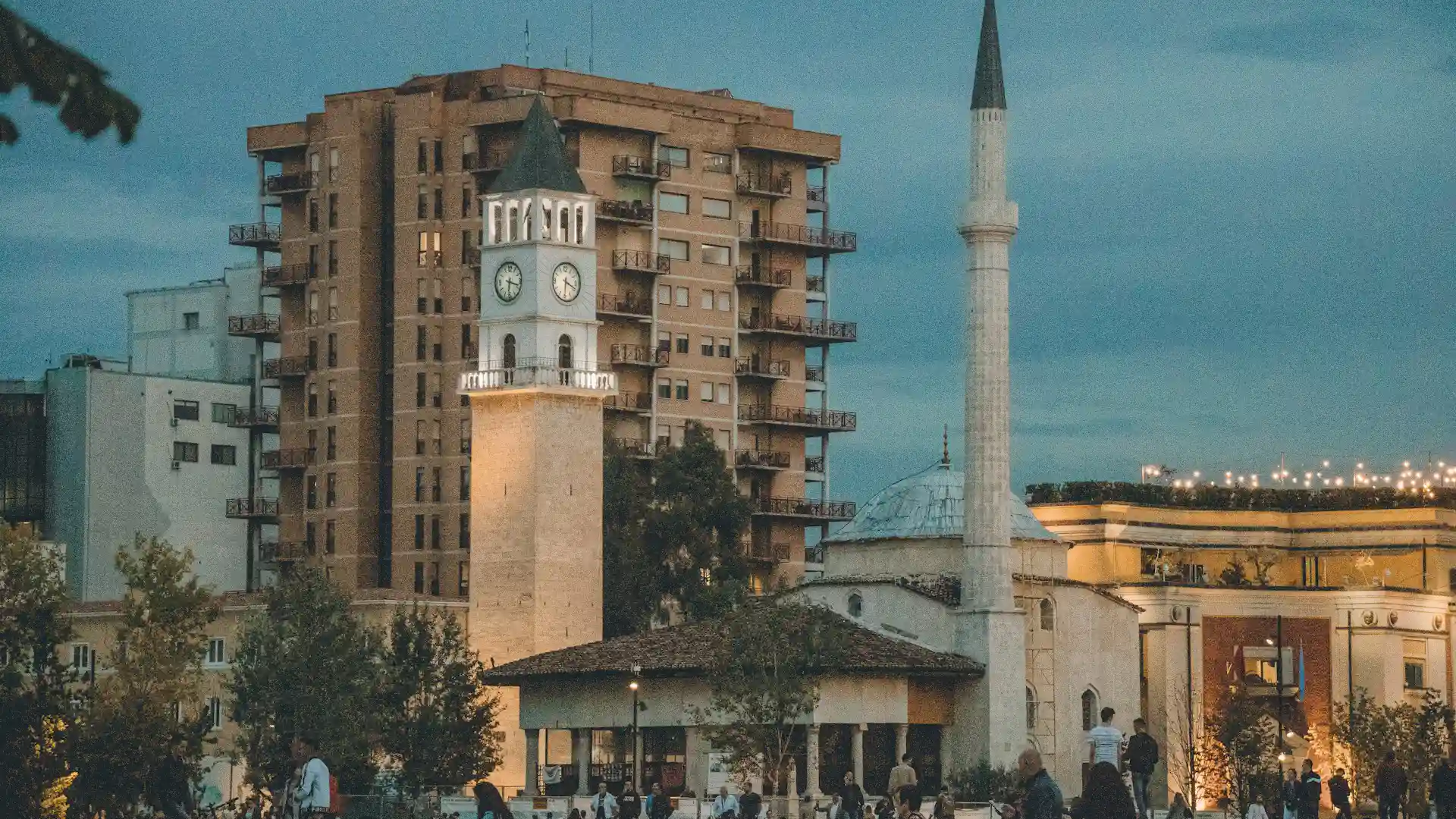
Albania’s cities and regions offer different snapshots of the country. Tirana is the main political and economic centre, with government offices, universities, museums and a dense café scene clustered around Skanderbeg Square and nearby neighbourhoods. Durrës, on the Adriatic, is the principal port and one of Albania’s oldest cities, with a Roman amphitheatre and seaside promenade.
Further south, Vlorë marks the point where the Adriatic meets the Ionian Sea and is historically important as the site of the 1912 Declaration of Independence. Beyond Vlorë, the coastal road climbs over the Llogara Pass and follows the Albanian Riviera, offering views of cliffs, coves and villages such as Himarë and Dhërmi. In the north, Shkodër stands near Lake Shkodra and Rozafa Castle and acts as a gateway to the Albanian Alps. In the interior, Berat and Gjirokastër are UNESCO-listed historic cities with hillside houses and castle districts that show Ottoman-era urban forms.
| City / Region | Role | Known for |
|---|---|---|
| Tirana | Capital & largest city | Government, business, universities, museums, café culture |
| Durrës | Main Adriatic port | Port, Roman amphitheatre, seaside holidays |
| Vlorë & Albanian Riviera | Southern coast | Independence history, beaches, coastal road and sea views |
| Shkodër & Albanian Alps | Northern hub | Lake Shkodra, Rozafa Castle, access to Valbonë and Theth |
| Berat & Gjirokastër | Historic towns | UNESCO architecture, castle districts, stone and whitewashed houses |
Transport & Getting Around
Most international visitors enter Albania through Tirana International Airport, located about 11 miles (18 kilometres) northwest of the capital. A smaller regional airport near Kukës serves a limited number of routes. Ferries connect Durrës and Vlorë with Italian ports such as Bari and Brindisi, while Sarandë has links to Corfu in Greece in summer.
Within the country, people travel mainly by road. Intercity buses and minibuses (known locally as furgons) run between major towns, and many visitors choose to rent a car, especially to explore coastal or mountain regions. Road quality varies: main corridors have been upgraded, while some rural and mountain roads can be narrow and winding. Railway services exist but are limited and slower than road travel.
History in Brief
The territory of present-day Albania has been inhabited since prehistoric times. In antiquity, various Illyrian tribes lived along the Adriatic coast and inland valleys. Over time, the region became part of the Roman Empire and later the Byzantine Empire, tying it into wider Mediterranean trade and politics.
During the Middle Ages, local principalities and kingdoms arose, including the Principality of Arbër and other entities that tried to balance powerful neighbours. From the late 14th and 15th centuries, the expanding Ottoman Empire brought most Albanian lands under its control. The military leader Gjergj Kastrioti Skanderbeg led a long resistance in the mid-1400s and remains a national hero, but the Ottomans eventually consolidated authority. Ottoman rule, which lasted for several centuries, shaped religion, urban architecture, land tenure and social structures.
In the 19th century, as the Ottoman Empire weakened, the Albanian National Awakening saw intellectuals and activists work to standardise the Albanian language and press for autonomy. Modern statehood dates from 28 November 1912, when Albanian leaders in Vlorë declared independence. The early decades of the 20th century were turbulent: Albania passed through periods as a principality, a republic and a kingdom, and was occupied by Italy in 1939 and Nazi Germany later in the Second World War.
After 1944, communist partisans led by Enver Hoxha established a tightly controlled socialist state. Albania became one of Europe’s most closed countries, with nationalised industry, collectivised agriculture and restrictions on religion and foreign contact. Only in 1990–1992 did multi-party politics and market reforms begin, as the regime collapsed in line with wider changes in Eastern Europe. The 1990s brought both democratisation and instability, including the 1997 crisis linked to pyramid investment schemes.
Since the 2000s, Albania has focused on stabilising institutions and integrating with European and global structures. Joining NATO in 2009 and opening EU accession negotiations in 2022 are key milestones. By the mid-2020s, the opening of all negotiation clusters signalled a deeper phase in the EU process. While challenges remain, recent history is largely a story of opening up, reform and connection to regional and international frameworks.
| Period / Year | Key event |
|---|---|
| Ancient era | Illyrian tribes inhabit the region; later incorporated into the Roman and then Byzantine Empires. |
| 14th–15th centuries | Ottoman Empire gains control; Skanderbeg leads notable resistance but Ottoman rule is established. |
| Late 19th century | Albanian National Awakening promotes language, schools and autonomy within the shrinking Ottoman Empire. |
| 1912 | Declaration of Independence in Vlorë creates the modern Albanian state. |
| 1939–1944 | Italian, then German occupation during the Second World War. |
| 1944–1990 | Communist regime under Enver Hoxha and successors; closed, centrally planned system. |
| 1990–1992 | Transition to multi-party democracy and market reforms. |
| 1997 | Crisis linked to failed pyramid schemes leads to unrest and international involvement. |
| 2009 | Albania joins NATO. |
| 2014–2025 | Granted EU candidate status in 2014; EU accession talks open in 2022 and all negotiation clusters are opened by 2025. |
Challenges & Future Trends
Demography & Migration
Albania faces a clear demographic challenge. The 2023 census confirmed that the resident population has fallen by more than 400,000 people since 2011, as lower birth rates and emigration reduce numbers. Younger and highly educated people are particularly likely to move abroad, which can lead to skills shortages and ageing communities at home.
Jobs, Growth & Innovation
Economic growth has been steady but not spectacular, and unemployment—especially among young adults—remains a concern. Strengthening education and vocational training, improving the match between skills and jobs, and supporting small and medium-sized businesses are all priorities. There is growing interest in digital services, start-ups and technology parks, which could open new paths for higher-value jobs if backed by stable rules and infrastructure.
Governance & Rule of Law
Reforms to strengthen the rule of law, curb corruption and modernise the justice system are central to both domestic expectations and EU accession conditions. Vetting processes for judges and prosecutors, the digitalisation of public services and efforts to increase transparency are under way, but public trust in institutions is still a work in progress. Sustained progress in these areas will strongly shape Albania’s political and economic future.
Environment & Climate
On the environmental side, Albania’s rivers, forests and coasts provide both economic opportunities and important ecosystems. Expanding tourism and hydropower can bring income but also raise questions about land use, water quality and habitat protection. Climate change may increase risks from heatwaves, droughts and floods, affecting agriculture, hydropower output and coastal areas.
The creation of the Vjosa Wild River National Park and the recognition of the wider Vjosa Valley as a UNESCO Biosphere Reserve are signs of a growing focus on conservation and eco-tourism. The long-term challenge is to protect natural assets while also improving living standards and infrastructure across all regions, so that environmental and social goals reinforce each other rather than compete.
FAQ
Is Albania safe to visit?
Most visitors find Albania generally safe, especially in main tourist areas and larger cities. As in many countries, petty crime such as pickpocketing can occur, so it is wise to keep valuables secure, use licensed taxis and follow local advice. For official safety guidance, travellers should check current advice from their own government before departure.
What language is most useful for visitors to Albania?
Albanian is the official language and the main language of daily life. In Tirana, coastal towns and tourist sites, many people—especially younger Albanians—also speak English or Italian, and some speak Greek. Knowing a few basic Albanian phrases is appreciated, but English will usually be enough for hotels, many restaurants and tours.
Is Albania expensive compared with other countries in its region?
Albania is generally cheaper than many Western European countries and is broadly similar to, or slightly less expensive than, some neighbouring Balkan states. Food, local transport and mid-range accommodation can be good value. Prices on the most popular beaches in peak summer are higher, but overall costs remain moderate by European standards.
What is Albania best known for?
Albania is known for its mix of high mountains and Mediterranean coast, the Albanian Riviera beaches, historical cities like Berat and Gjirokastër, and the rugged Albanian Alps. It is also noted for its religious diversity, traditional polyphonic music and its post-communist transition toward NATO membership and a future place in the European Union.
What is the climate like in Albania?
The coast has a Mediterranean climate with hot, dry summers and mild, wet winters. Inland areas are hotter in summer and colder in winter, while mountain regions see frequent snow in colder months. In Tirana, typical summer daytime highs are around the upper 80s°F (about 30°C), and winter daytime temperatures often sit in the low 40s°F (about 5–6°C).
Do you need a visa to visit Albania?
Visa rules depend on your nationality. Many visitors from Europe and several other regions can enter visa-free for short stays, while others need a visa in advance. Because rules change, travellers should always check the latest information on Albania’s official government or consular websites before planning a trip.
What currency does Albania use, and can you pay with euros?
The currency is the Albanian lek (ALL). In tourist areas, some hotels and larger businesses may quote prices in euros and sometimes accept them, but everyday payments are usually in lek. It is practical to withdraw lek from ATMs on arrival and keep some cash for smaller shops, markets and buses.
What Did We Learn Today?
- Albania is a small, mountainous country on the western Balkan Peninsula with a coastline on the Adriatic and Ionian Seas.
- About 2.4 million people live in Albania as of the 2023 census, with a growing majority living in cities such as Tirana and Durrës.
- Albania is a parliamentary republic, a NATO member since 2009 and an EU candidate country that has opened all negotiation clusters by 2025.
- Its landscapes range from the Albanian Alps and wild rivers like the Vjosa to sandy Adriatic beaches and the cliff-backed Albanian Riviera.
- The country faces demographic, economic and governance challenges but has real opportunities in tourism, renewable energy, digital services and closer European integration.
Sources & Data Notes
Key figures in this Albania country profile draw on Albania’s national statistics institute (INSTAT) and the 2023 Population and Housing Census, World Bank country data (including GDP per capita and urbanisation), UNDP Human Development Reports (HDI values and rankings), NATO and European Union official information on Albania’s membership and EU accession process, UNESCO material on World Heritage and biosphere designations, and reputable geographic references for physical geography, climate and protected areas. Values are rounded for clarity and may be updated as new datasets appear.